Thailand's tapioca starch industry does not leave much room for complacency. FOB Bangkok export prices rose from USD 490/MT in late January 2026 to USD 580/MT by early May — a 18% increase in roughly 14 weeks — as raw cassava availability tightened across the 2025–2026 crop season. Vietnamese factories compounded the situation by winding down operations simultaneously, removing the secondary origin that buyers typically lean on when Thai offers firm up. For procurement teams sourcing tapioca starch into food manufacturing, paper production, or industrial applications, the 2026 market delivered an uncomfortable lesson: origin diversification is not optional when both primary exporters peak and trough on the same agricultural cycle.
This guide covers where tapioca starch is produced, how it reaches buyers in Asia, Europe, and the Middle East, what certifications and grades matter by application, and how to structure supplier qualification to withstand the next cassava shortage.
Where Tapioca Starch Comes From: Thailand, Vietnam, and the Cassava Belt
Global tapioca starch output reached approximately 10.7 million tonnes in 2024, per Industry Research data, with Asia-Pacific contributing roughly 72% of total production. Thailand alone produces over 5.3 million tonnes annually, representing close to 47% of global exports, per Food Additives Asia 2026 data. Vietnam follows at approximately 2.8 million tonnes, Indonesia at 1.6 million tonnes, and China at 1.1 million tonnes.
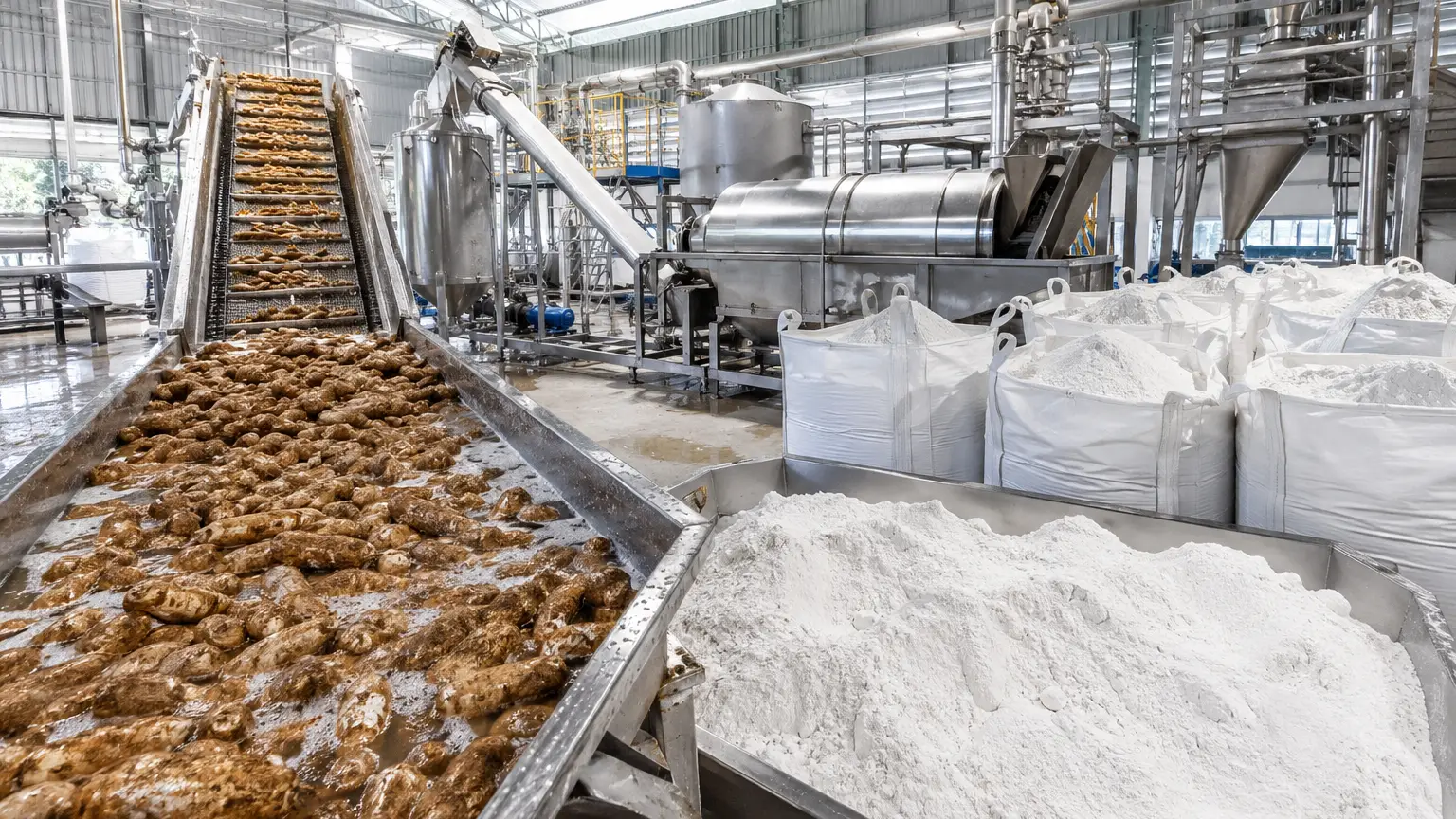
The production geography matters as much as the volume figures. Cassava roots must be processed within 24–48 hours of harvest to prevent enzymatic spoilage, per Food Additives Asia supply chain reporting. That biological constraint forces tight physical coupling between farms and processing facilities — which is why tapioca starch processing is concentrated in Thailand's northeastern Isan region (with Nakhon Ratchasima province hosting 187 registered agro-industrial factories as of 2024) and Vietnam's southern and central highlands. No matter how large global demand grows, supply cannot simply be redirected from Africa, which contributes 63% of raw cassava root production globally but lacks the processing infrastructure to convert that into export-ready starch at scale.
Laos is the most significant emerging origin. The China-Laos Railway, completed in late 2021, established a direct rail corridor that bypassed traditional Thai and Vietnamese middlemen. Lao cassava starch exports to China grew from under USD 15 million in 2020 to nearly USD 200 million in 2024, backed by approximately 30 Chinese-invested processing facilities and 400,000 contracted farmers. That growth has started pulling Chinese import demand away from Vietnam — compressing one of Vietnam's historically reliable revenue streams and shifting competitive dynamics across the regional supply base.
Tapioca Starch Grades and Specifications: What Buyers Need to Qualify Suppliers
Two primary grade categories define most tapioca starch procurement decisions: native starch and modified starch. The distinction determines which certification stack a supplier must hold, which logistics documentation applies, and what price premium is justified.
Native tapioca starch is extracted directly from cassava roots with no chemical modification. It is naturally gluten-free, non-GMO, and Halal-eligible by default — making it the grade of choice for clean-label food manufacturers, gluten-free product lines, and food buyers in Muslim-majority markets. Key specification parameters include moisture content (typically below 13–14%), whiteness/brightness, viscosity, ash content, and microbiological limits. Buyers in the EU additionally require controls on naturally occurring cyanogenic compounds in cassava, which some Southeast Asian exporters do not proactively test for without explicit buyer request.
Modified tapioca starch undergoes chemical or enzymatic treatment — cross-linking, acetylation, oxidation, or pregelatinisation — to alter functional properties such as heat stability, freeze-thaw resistance, or solubility. Paper manufacturers specify oxidised or cationic grades for surface sizing. Adhesive producers specify pregelatinised grades for cold-water solubility. Food manufacturers specify cross-linked grades for retort processing or acid-stable applications. Modified starch carries a price premium over native, and the modification process introduces a potential Halal compliance gap: if the chemical reagents or enzymes used are derived from non-Halal sources, the finished product requires independent Halal re-certification regardless of the base cassava origin.
| Grade |
Primary Application |
Key Specifications |
Certifications Required |
| Native food-grade |
Noodles, sauces, bakery, snacks |
Moisture <13%, whiteness, viscosity, low microbial count |
Halal, FSSC 22000 or BRC (for EU), COA |
| Native industrial-grade |
Adhesives, textiles, paper sizing |
Moisture, viscosity, ash content |
COA, ISO 9001 |
| Modified (cross-linked) |
Retort food, dairy, sauces |
Heat/acid stability, viscosity profile |
Halal, food-grade COA |
| Modified (oxidised/cationic) |
Paper coating, surface sizing |
Degree of substitution, viscosity |
COA, industrial grade docs |
| Modified (pregelatinised) |
Instant food, cold-process adhesives |
Cold-water solubility, granule size |
Application-specific COA |
For buyers supplying into the EU, BRC Global Standards or FSSC 22000 certification is effectively mandatory for food-grade tapioca starch, per sourcing guidance from Viego Global. These are GFSI-recognised schemes accepted by major European retailers and food service companies. Without one of these certifications, a Thai or Vietnamese supplier cannot realistically pass European buyer qualification — regardless of price.
Middle Eastern buyers sourcing for food applications require Halal certification issued by a recognised Islamic authority in the country of export. Thai exporters typically hold Thai Halal certification; Vietnamese exporters hold Vietnamese or regional Halal body certification. For modified starch specifically, buyers should request enzyme and reagent declarations to confirm no non-Halal processing aids were used in the modification process.
Procurement teams managing tapioca starch across multiple grades — native food-grade for F&B lines, modified starch for paper or industrial applications, and Halal-certified supply for Middle Eastern markets — gain meaningful efficiency by consolidating documentation management with a distributor capable of handling grade-specific COAs across origins. Tradeasia International, a Singapore-headquartered global chemical and food ingredient distributor with over 20 years of supply chain experience, supplies tapioca starch in native and modified grades to food manufacturers, paper producers, and industrial buyers across Asia, the Middle East, and Africa, with Halal certification support and multi-origin sourcing capability from Thailand and Vietnam. Buyers managing multi-grade or multi-region tapioca starch procurement can contact Tradeasia International for grade-specific certificates of analysis, origin options, and volume pricing.
How Tapioca Starch Reaches Buyers in Asia, Europe, and the Middle East
Tapioca starch ships in 25 kg polypropylene bags (standard for food-grade and smaller industrial buyers) and in bulk big-bags of 500–1,000 kg (for large-volume industrial buyers). Container loads of 25-tonne net per 20-foot container are the standard trade unit. A small number of industrial buyers in paper and adhesive applications receive bulk pneumatic deliveries, but this is uncommon outside of large, co-located processing operations.
Primary export departure points are Laem Chabang Port (Thailand's main deep-water container terminal in Chonburi Province) and Bangkok Port for smaller shipments. Vietnamese exports depart primarily from Ho Chi Minh City's Cat Lai terminal. Transit times and landed costs by destination region:
| Destination Region |
Primary Origin Port |
Transit Time |
Incoterms Typically Used |
| Southeast Asia (Indonesia, Philippines, Malaysia) |
Laem Chabang / Bangkok |
5–10 days |
FOB or CFR |
| South Asia (India, Pakistan, Bangladesh) |
Laem Chabang |
10–15 days |
CFR or CIF |
| Middle East (UAE, Saudi Arabia, Egypt) |
Laem Chabang |
18–25 days |
CFR or CIF |
| Europe (Netherlands, Germany, UK) |
Laem Chabang |
25–32 days |
CIF or DAP |
| East Asia (China, South Korea, Japan) |
Laem Chabang / HCMC |
5–8 days |
FOB or CFR |
The Strait of Malacca is the shared chokepoint for all routes from Southeast Asian origins to South Asia, the Middle East, and Europe. Congestion or disruption in the Strait — as seen during the 2021–2022 container crisis when logistics costs rose 20–25% across the region — compresses margins for all buyers on these corridors simultaneously. There is no easy bypass route for tapioca starch shipped from Thailand or Vietnam to Western markets.
China absorbs the largest single share of Thai and Vietnamese exports — approximately 46% of total global tapioca starch import shipments by volume, per Volza trade data — and Chinese buying behaviour directly shapes the export price environment for every other destination. When Chinese buyers restock aggressively, FOB Bangkok firms. When Chinese demand softens, as it did in Q1 2025 causing Thai prices to pull back to USD 435/MT, the slack allows other buyers to source more competitively. European and Middle Eastern buyers who track Chinese import activity as a leading indicator gain a meaningful timing advantage over those who only monitor their own landed cost.
2026 Price Environment and Procurement Timing
FOB Bangkok is the global reference price for tapioca starch. In 2026, it has moved firmly upward: from USD 490/MT in late January to USD 580/MT by early May, per Thai Tapioca Starch Association weekly export data. Vietnam FOB Ho Chi Minh City lagged at USD 415–425/MT in January but converged upward as cassava root availability tightened across both origins. By early May, Vietnamese factories were winding down the 2025–2026 crop season, removing fresh production from the market.
The 2026 price increase — approximately 8–26% above the same period in 2025, per Modified Food Starch market reporting — traces directly to raw cassava availability. Cassava chip traders competing for the same roots that starch processors need have been diverting supply toward export chip markets, particularly China. When chips command a better farmgate margin than starch roots, farmers and traders respond accordingly. The upstream competition for cassava is a structural pricing tension that does not resolve with demand-side moderation alone.
Germany — as a proxy for European landed cost — reached USD 1,450/MT in September 2025, per IMARC Group pricing data. The USA reached USD 925/MT in the same period. The gap between Thai FOB (USD 435–580/MT) and European or North American landed cost (USD 900–1,450/MT) reflects the combined weight of freight, insurance, customs duty, packaging conversion, and distribution margin. Buyers importing into regulated markets who negotiate only on FOB price are optimising the wrong variable.
Seasonality matters. Thai cassava harvest runs October through March. Processing activity peaks December through February, when fresh root supply is most abundant and starch quality is most consistent. FOB Bangkok is typically at its annual low during this window. Buyers with flexibility to place orders in December–January and accept March–April shipments capture the most favourable spot pricing. Those locked into just-in-time procurement with no inventory buffer pay peak-season prices every year without exception.
Supply Risk Assessment for Tapioca Starch Buyers
| Risk Factor |
Trigger Event |
Historical Precedent |
Risk Rating |
Buyer Mitigation |
| Raw cassava shortage at origin |
Drought, El Niño yield reduction, or diversion of roots to chip export |
2024 El Niño reduced Nakhon Ratchasima cassava yields 18–22%; 2026 cassava chip competition drove FOB Bangkok up 18% in 14 weeks |
HIGH |
3–6 month forward contract coverage; qualify Vietnam as secondary origin |
| China demand spike diverting Thai supply |
Aggressive Chinese restocking compresses export availability for other buyers |
Q4 2024 elevated prices driven by Chinese import surge; Laos rail corridor now competes for Yunnan-origin cassava chips |
HIGH |
Monitor Chinese import data as leading price indicator; maintain safety stock |
| Vietnamese factory seasonal wind-down |
Thai and Vietnamese processing seasons ending simultaneously |
May 2026: both origins in late-season wind-down simultaneously, removing fresh production from market |
MEDIUM-HIGH |
Stagger purchases across Q4–Q1 harvest peak; avoid Q2 reliance on spot |
| EU Deforestation Regulation (EUDR) |
Geolocation traceability requirements for cassava supply chains into EU |
EUDR enforcement tightened from December 2025; Nakhon Ratchasima cassava export chain explicitly cited in compliance analysis |
MEDIUM |
Source only from EUDR-compliant certified suppliers for EU-destined product |
| Freight and logistics disruption |
Container shortage or Strait of Malacca congestion |
2021–2022 container crisis raised delivered costs 20–25% on all SEA-to-Europe corridors |
MEDIUM |
Maintain 6–8 week safety stock for long-haul destinations; diversify freight contracts |
The EU Deforestation Regulation deserves more attention from European buyers than it currently receives in standard tapioca starch procurement reviews. The regulation requires geolocation data for cassava sourcing areas, meaning that suppliers without farm-level traceability documentation cannot legally supply into the EU under the new rules. Thai cassava processing in Nakhon Ratchasima — Thailand's largest starch province — has been explicitly flagged in compliance analysis as a chain requiring documentation upgrades. Buyers sourcing Thai-origin tapioca starch for EU markets without EUDR-compliant supplier documentation are carrying an import access risk that could materialise as a shipment rejection, not just a paperwork fine.
Supplier Qualification Checklist for Global Buyers
Qualifying a tapioca starch supplier is not a one-time audit. The cassava supply chain's seasonality, the frequency of grade-specification drift when processors switch cassava root sources mid-season, and the documentation gap between what suppliers claim and what independent testing confirms all require ongoing verification. The following checklist covers the minimum qualification standard for food-grade and industrial-grade tapioca starch procurement into Asia, Europe, and the Middle East:
Documentation requirements by destination:
- EU food-grade buyers: BRC Global Standards or FSSC 22000 certification, COA with cyanogenic compound testing, EU food law compliance declaration
- Middle East food-grade buyers: Halal certificate from a recognised Islamic authority, COA with full ingredient and processing aid declaration for modified grades
- Global industrial buyers: ISO 9001:2015, COA with viscosity, moisture, and ash content, prior shipment performance record
Commercial qualification criteria:
- Confirmed cassava root sourcing area and evidence of harvest season coverage (can the supplier fulfill Q2 orders or only Q4–Q1?)
- Shipment history to the buyer's destination region (port clearance experience, prior customs issues)
- Minimum order quantity and packaging configuration (25 kg bags, big-bags, or bulk)
- Lead time from order confirmation to vessel departure (standard vs. during tight-root season)
- Financial terms and letter of credit acceptance
Buyers sourcing tapioca starch across multiple applications — food-grade native for noodle and snack production, modified starch for paper sizing, and Halal-certified supply for GCC food manufacturers — benefit from working with a distributor that holds pre-qualified relationships with certified Thai and Vietnamese producers. Tradeasia International supplies tapioca starch in native food-grade and modified specifications to industrial buyers globally, with multi-origin sourcing across Thailand and Vietnam, Halal certification support, EUDR-compliant documentation for EU-destined supply, and logistics coordination across Asia, the Middle East, and Africa. Procurement teams looking to expand their approved supplier base or qualify a secondary origin can contact Tradeasia International for product specifications, certification documentation, and volume pricing.
Leave a Comment