
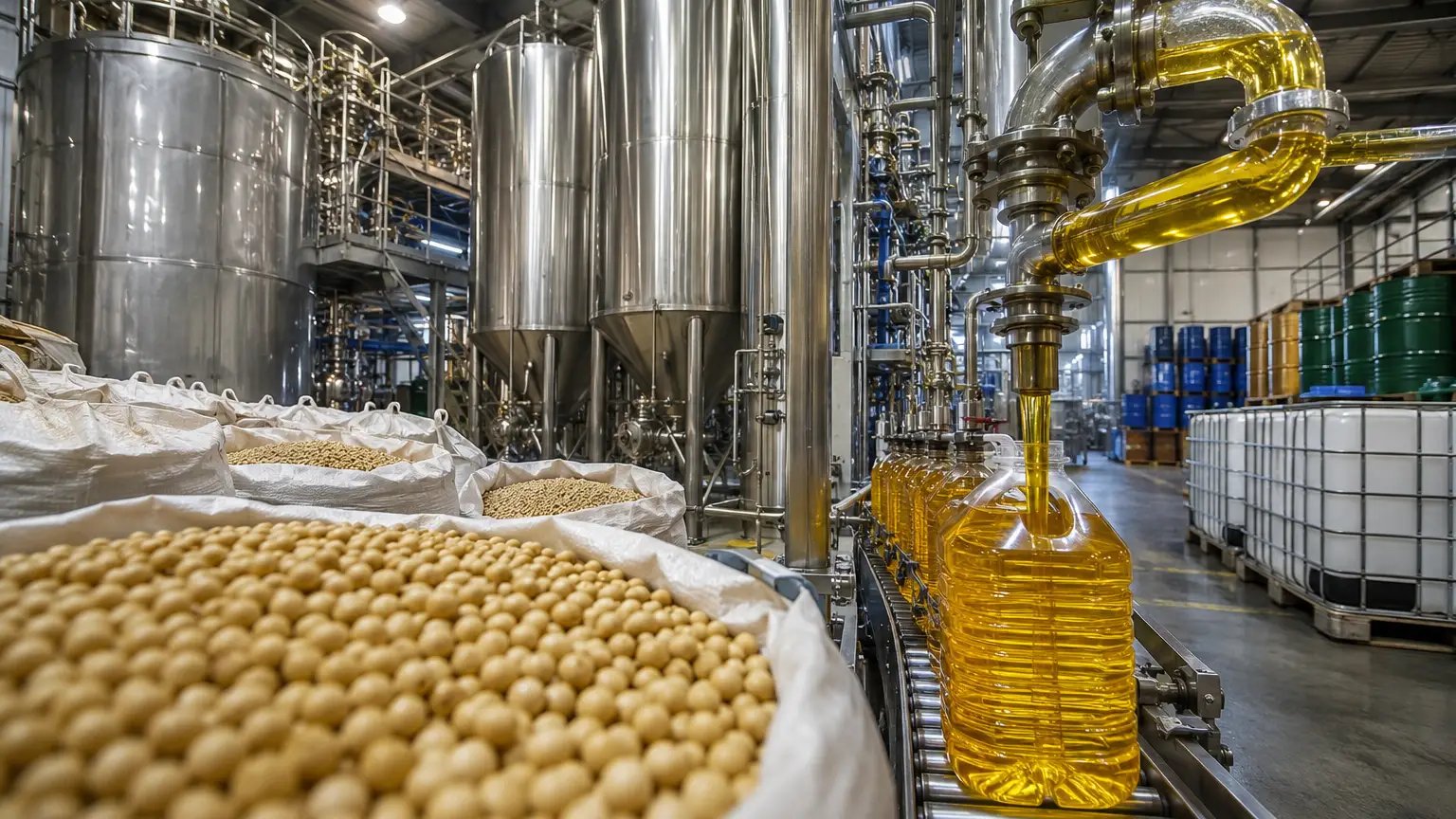
Argentina and Brazil together operate the largest soybean crushing complex on earth, and yet procurement teams across Asia, the Middle East, and Europe regularly face supply gaps, price spikes, and quality inconsistencies when sourcing soybean oil from these origins. The gap between where the oil is produced and how reliably buyers can access it reflects a structural mismatch at the center of global soybean oil trade: supply is geographically concentrated in two countries, but demand is distributed across dozens of importing markets with different grade requirements, certification standards, and logistics constraints. The global soybean oil market was valued at approximately USD 51.4 billion in 2025 and is projected to reach USD 66.3 billion by 2030 at a CAGR of 5.25% (Research and Markets, 2025). For procurement teams navigating that market, origin selection, grade specification, and supplier qualification are not secondary concerns: they determine whether the supply chain holds under pressure.
The Global Production Landscape: Where Soybean Oil Actually Comes From
Soybean oil is a co-product of soybean crushing, which means its supply is structurally tied to meal demand rather than edible oil demand independently. When crushing activity increases to supply protein meal to poultry and aquaculture feed markets, oil output rises as a by-product regardless of edible oil price signals. This co-product dynamic is the first thing procurement teams need to internalize: soybean oil supply can tighten or loosen not because of changes in food oil demand, but because of shifts in crush margins driven by meal markets.
Argentina hosts the world's single most concentrated soybean crushing infrastructure, clustered in a 70-kilometer corridor along the Paraná River between Rosario and San Lorenzo. This corridor processes a significant share of global crushing output, making it the dominant origin for soybean oil exports to Europe, North Africa, and Asia. Argentina exports approximately 3.1 million metric tons of soybean oil annually (Tradologie, 2025), and its advanced refining capabilities produce high-purity grades suitable for food and industrial applications. The risk for buyers is structural: Argentina's export tax regime, periodic currency distortions, and seasonal harvest concentration all create procurement windows that buyers must anticipate rather than react to.
Brazil is the world's largest soybean producer, with the 2025/26 USDA WASDE projecting output above 175 million metric tons, but its primary export is the whole bean rather than the processed oil. China absorbs approximately 60% of global soybean imports as whole beans for domestic crushing, leaving a smaller proportion of Brazilian oil available for third-country buyers. For procurement teams in Asia and the Middle East, this distinction matters: Brazil's production dominance does not translate directly into Brazilian oil supply security.
The United States is the third major origin, with soybean oil exports concentrated through Gulf of Mexico ports at New Orleans and Baton Rouge, with secondary volumes from Pacific Northwest terminals. U.S. soybean oil pricing is anchored to CME Group CBOT futures, and the biofuel sector's claim on domestic supply is a material variable. USDA projected approximately 15.5 billion pounds of U.S. soybean oil going to biofuel production in the 2025/26 marketing year, representing over half of total U.S. soybean oil use (USDA WASDE, July 2025). When renewable diesel policy incentives tighten the domestic balance sheet, export availability contracts rapidly, and buyers relying on U.S. origin as a primary source face allocation risk.
Paraguay has emerged as a meaningful secondary origin for buyers sourcing parcels below 5,000 metric tons. USDA's 2025/26 projections show Paraguay among the few origins with rising production estimates, and its export tax structure is more favorable than Argentina's. Buyers in South and Southeast Asia, Bolivia, Peru, and parts of the Middle East are increasingly treating Paraguay as a viable supplementary source for smaller-volume procurement, though it cannot replace Argentina or Brazil for large-volume buyers requiring 10,000 metric tons or more per month.
Soybean Oil Grades: What Procurement Teams Must Specify
Sourcing failures in soybean oil procurement are rarely caused by choosing the wrong origin. More often, they result from misspecifying grade, or from accepting supplier documentation that conflates grade terminology in ways that create quality problems downstream. Three commercially significant grade categories define the market.
Crude Degummed Soybean Oil (CDSO)
Crude degummed soybean oil is the primary output of the crushing and degumming stage, before full refining. It contains free fatty acids (typically 0.5-1.0% FFA), phosphatides, and residual impurities that limit its direct use in food applications but make it a suitable feedstock for refiners, biodiesel producers, and oleochemical manufacturers. CDSO is the most widely traded bulk form globally and is priced closest to the CBOT futures benchmark. Buyers sourcing CDSO need to specify maximum FFA content, phosphorus levels (relevant for both food refining and biodiesel), moisture, and impurities tolerance. Argentine and Brazilian exporters publish standardized CDSO specifications, but batch variation is meaningful and COA verification is non-negotiable before vessel loading.
Refined, Bleached, and Deodorized Soybean Oil (RBD)
RBD soybean oil is the standard food-grade commercial product, produced through alkali refining (to reduce FFA and remove phosphatides), bleaching (to reduce color bodies), and steam deodorization (to remove volatile flavor and odor compounds). The result is a neutral, light-colored oil with FFA below 0.1%, suitable for direct use in cooking, frying, food processing, margarine production, and most industrial food applications. RBD is the grade specified by food manufacturers, FMCG companies, and foodservice distributors globally. Buyers should specify maximum FFA (typically less than 0.05% for food-grade), color (Lovibond scale), moisture content, and peroxide value. Refining capacity constraints, particularly in Argentina, can create lead-time premiums for RBD relative to CDSO during high-demand periods.
Identity-Preserved Grades: Non-GMO and High-Oleic
A structurally distinct tier of the market operates outside the commodity stream. Non-GMO soybean oil commands a premium from buyers supplying European retail, organic food brands, and markets with mandatory GMO labeling. Since no commercially viable GMO-free soybean cultivar exists in commodity supply chains, non-GMO oil requires identity-preserved (IP) handling from farm through processing, with documented segregation protocols and third-party verification at each transfer point. High-oleic soybean oil, derived from high-oleic soybean varieties with improved fatty acid stability, is a specialty grade targeting food manufacturers seeking extended fry-life and reduced saturated fat content. Procurement lead times for high-oleic grades run 18 to 24 months from demand signal to delivery for large volumes, given the coordination required between seed companies, growers, and processors.
Certifications That Gate Market Access
The certification landscape for soybean oil has become materially more complex since 2020, driven by the EU Deforestation Regulation (EUDR), biofuel sustainability mandates, and the expansion of clean-label requirements in retail markets.
EUDR compliance is the most consequential new requirement for buyers supplying EU markets or sourcing from South American origins. The EUDR requires that soybean oil placed on the EU market be deforestation-free and produced in compliance with local land and labor laws, verified through documented geolocation data traced to the plot of land where the soybeans were grown. Suppliers unable to provide EUDR-compliant documentation face restricted EU market access. For buyers, this means supplier qualification must now include assessment of traceability infrastructure, not just product specifications.
RSPO and equivalent certification applies primarily to palm oil but has prompted soybean oil buyers in sustainability-sensitive markets to seek analogous assurances. The Round Table on Responsible Soy (RTRS) certification and the ProTerra Standard serve equivalent functions in soybean supply chains, verifying that production avoids deforestation and respects social standards. These certifications are increasingly specified by European food manufacturers, and their absence is beginning to affect supplier qualification decisions in North American premium food markets as well.
HALAL and Kosher certification is a market access requirement, not a quality differentiator, for buyers supplying Muslim-majority or Jewish-community food markets. Soybean oil is plant-derived and intrinsically compliant with both dietary requirements, but processing facility certification and supply chain documentation must be current and issued by recognized certifying bodies to satisfy regulatory and retail compliance requirements.
Non-GMO and organic certification governs identity-preserved supply chains where applicable. For buyers in markets with mandatory GMO labeling (the EU, China, and a growing number of others), non-GMO documented oil is a market access requirement rather than a premium positioning choice.
Buyers seeking a soybean oil supplier with documented compliance across multiple certification frameworks, including HALAL, food-grade, and non-GMO, can review Tradeasia International's soybean oil product portfolio, which covers multiple grades and origins with full documentation support for regulated market access.
Trade Flows and Logistics: How Soybean Oil Moves Globally
Soybean oil moves primarily in bulk liquid form, transported in parcel tankers, ISO tank containers, and flexi-tanks depending on volume and destination. The primary export corridors from South America are through Argentine Paraná River terminals (Rosario, San Lorenzo, San Martin) and Brazilian Atlantic ports (Santos, Paranaguá). From the U.S., Gulf ports handle the majority of export volumes.
Transit times from Argentine origins to major Asian destinations average 25 to 35 days via the Cape of Good Hope route, and 35 to 45 days via the Suez Canal depending on vessel routing and port congestion. U.S. Gulf to Asian destinations via Panama Canal average 30 to 45 days. These transit windows are commercially significant for buyers managing production scheduling: lead times for South American origin soybean oil commonly require procurement decisions 60 to 90 days ahead of required delivery.
The Middle East is the fastest-growing regional import market for soybean oil, growing at a projected 6.72% CAGR through 2030 (Mordor Intelligence, 2025), driven by food security investment programs and expanding poultry and aquaculture feed industries. Saudi Arabia's Public Investment Fund is acquiring stakes in oilseed crushing facilities, which may partially reduce import dependence over a five-to-ten year horizon, but the region remains structurally import-dependent for the foreseeable future. Asia-Pacific, led by China and India, accounts for approximately 43 to 47% of global soybean oil consumption and is the primary destination for South American export volumes.
Supplier Qualification: What Separates Reliable Supply from Price-Only Sourcing
Soybean oil procurement failures are disproportionately caused by selecting suppliers based on headline price rather than on an assessment of the full delivered cost and the supplier's actual control over the supply chain. A supplier quoting competitive FOB prices may have no physical control over refining capacity, packaging lines, or port scheduling, meaning that when the market tightens, priority allocation goes to buyers with long-term relationships and volume commitments rather than spot inquirers.
Effective supplier qualification for soybean oil should assess four dimensions. First, supply chain position: does the supplier operate or have contracted access to crushing, refining, and loading infrastructure, or are they a trading intermediary dependent on spot market access? This distinction determines reliability under allocation-driven conditions. Second, documentation capability: can the supplier provide batch-specific COAs with full analytical results for FFA, peroxide value, color, moisture, and fatty acid composition, along with applicable certification documents, within commercially reasonable timelines? Third, origin flexibility: can the supplier provide soybean oil from multiple origins (Argentina, Brazil, U.S., Paraguay) to enable buyers to diversify against single-origin risk? Fourth, logistics integration: does the supplier have established relationships with parcel tanker operators, ISO tank providers, and freight forwarders to secure shipping capacity during peak demand periods?
Global trading intermediaries with established multi-origin sourcing networks reduce the administrative burden of managing multiple direct supplier relationships while providing origin diversification. Tradeasia International operates as a verified soybean oil trading partner with sourcing access across South American and North American origins, supporting procurement teams with full documentation packages, grade-specific COAs, and logistics coordination for bulk and containerized shipments. Buyers evaluating multi-origin soybean oil supply strategies can contact Tradeasia International for origin-specific specifications and volume pricing.
Procurement Risks and How to Structure Against Them
Three structural risks dominate soybean oil procurement decision-making in 2025 and 2026.
The biofuel demand variable is the most acute near-term risk for buyers sourcing U.S. origin oil. Renewable diesel and sustainable aviation fuel (SAF) mandates have absorbed a growing share of U.S. soybean oil production, creating price spikes and supply tightening that transmit rapidly into food-grade markets. Buyers dependent on U.S. origin should monitor U.S. Environmental Protection Agency (EPA) Renewable Volume Obligation (RVO) announcements, which are the primary policy variable driving biofuel demand for soybean oil.
The South American harvest concentration risk is a structural feature of the market rather than an episodic risk. Argentine soybean oil exports are concentrated in the March to July post-harvest window. Buyers who place procurement orders outside this window face reduced availability and higher spot premiums. Maintaining standing quarterly supply agreements with Argentine or Brazilian exporters, with pricing indexed to CBOT futures plus a fixed basis, is the standard risk mitigation approach used by large industrial buyers.
The EUDR supply chain documentation requirement is a new and ongoing compliance risk for buyers supplying EU markets. Incomplete or non-verifiable origin documentation exposes buyers to import restrictions, fines, and reputational risk. Buyers should require EUDR-compliant documentation from South American suppliers before committing supply agreements, and should build 60 to 90 days of buffer stock during the transition period while supplier documentation systems mature.
Outlook: How the Global Soybean Oil Sourcing Landscape Is Shifting
The structural shift most relevant to procurement teams sourcing soybean oil over the next five years is not price direction, which will continue to be driven by crop cycles and biofuel policy, but the bifurcation of the market between commodity and certified supply chains. European deforestation regulation, clean-label retail requirements, and biofuel sustainability mandates are progressively separating buyers who can demonstrate compliant, traceable supply from those who cannot. Suppliers without investment in traceability infrastructure will face narrowing market access in high-value markets, while buyers without qualified certified suppliers in their approved vendor lists will face procurement constraints at the worst moments in the market cycle.
For food manufacturers, biodiesel producers, oleochemical companies, and feed compounders sourcing soybean oil globally, the commercially rational procurement posture is to diversify origins, pre-qualify certified suppliers across multiple grades, and establish supply agreements with lead times that match the logistical reality of South American-origin procurement rather than the headline availability of spot market prices.