
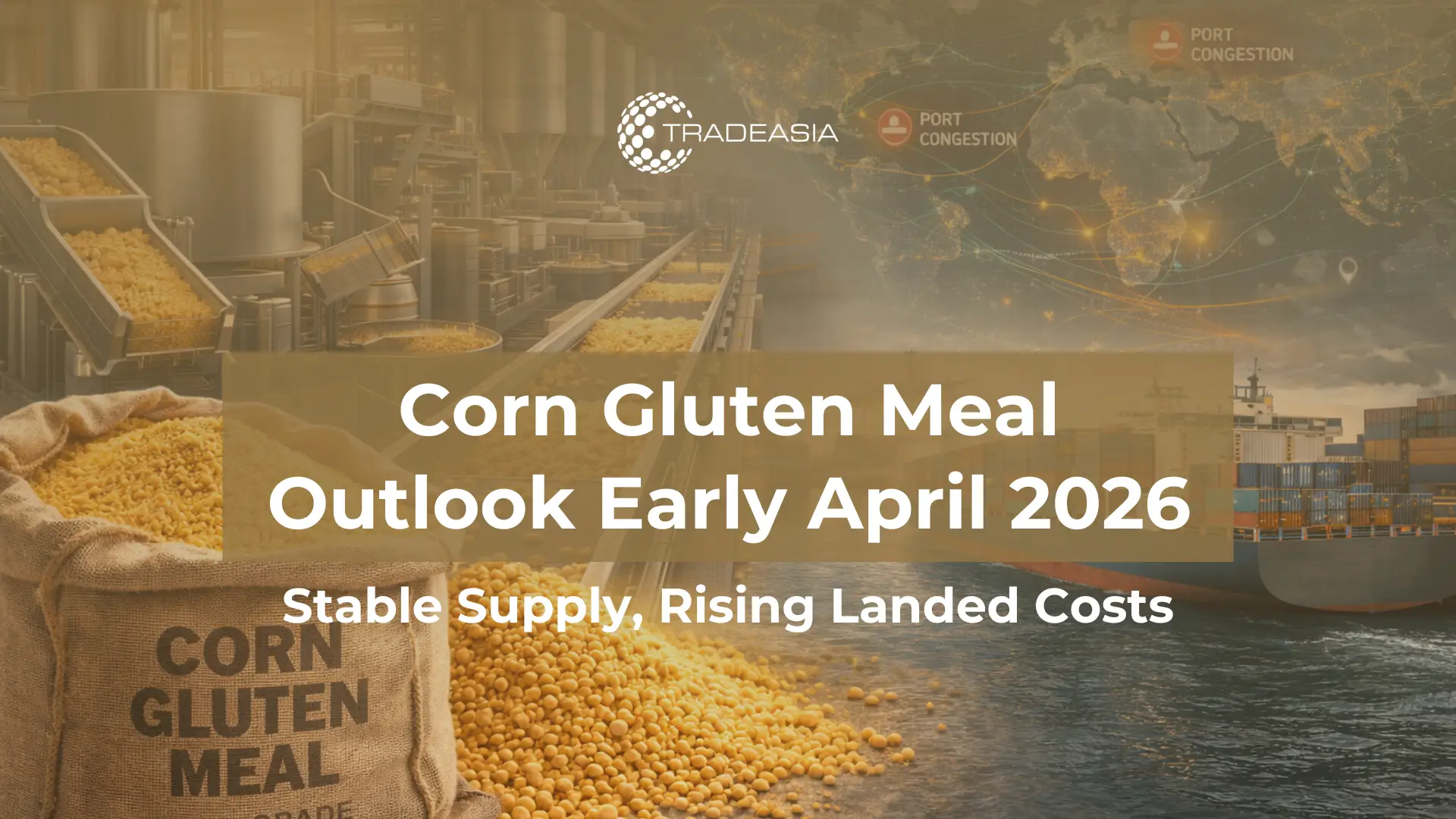
Corn Gluten Meal Market 2026 Is Stable at Origin
The corn gluten meal market 2026 is not being driven by a collapse in output. Current market research indicates that the sector is still expanding, with The Business Research Company estimating growth from about $8.58 billion in 2025 to $9.07 billion in 2026, supported by protein-rich feed demand and commercial aquaculture growth. (The Business Research Company)
That matters because it suggests the market’s biggest problem in early April 2026 is not supply absence at the mill level. Instead, the bigger challenge is whether product can move efficiently from large exporting origins to feed buyers facing higher transport costs and weaker route reliability. (The Business Research Company)
Stable output does not guarantee stable availability
According to UNCTAD, disruptions to maritime transport and global supply chains have become more frequent and consequential, with trading and shipping patterns being redrawn by geopolitical pressures around major chokepoints. That makes availability in destination markets increasingly dependent on logistics efficiency rather than pure production capacity. (UN Trade and Development (UNCTAD))
For feed buyers, this creates a market where source prices may still look manageable while actual arrival costs and timing remain volatile. That is the core reason why corn gluten meal logistics risk has become more commercially important than simple origin availability in early April 2026. (UN Trade and Development (UNCTAD))
Freight Disruption Is Driving the Current Price Story
The main reason why corn gluten meal prices are rising in some importing markets is freight pressure rather than a broad production shortage. UNCTAD says maritime trade is moving through a period of fragile growth, rising costs, and mounting uncertainty, which is raising the transport burden on globally traded commodities. (Maritime Executive)
In a commodity like corn gluten meal, where margins are often calculated on delivered cost rather than origin preference alone, shipping variability matters immediately. If routes become longer, containers become more expensive, or vessel schedules slip, the final landed quote can rise even when the cargo itself is still competitively priced at source. (Maritime Executive)
Transport has become the main market variable
Recent market coverage from Feed Ingredients Asia notes that buyers are dealing with higher container rates, vessel repositioning, and route changes that are making delivery windows harder to predict across Asia, the Middle East, and Africa. In practical terms, the corn gluten meal price trend is now being shaped as much by delivery efficiency as by feed-protein fundamentals. (Feedingredients Asia)
This is why early April 2026 looks like a distribution-driven phase of the market. Buyers are not reacting to a shortage of product at origin, but to the risk that cargo may arrive late, cost more than expected, or require more working capital to secure. (Feedingredients Asia)
Poultry, Aquaculture, and Pet Food Demand Still Support the Market
Demand remains strong enough to prevent the market from weakening materially. Current 2026 market coverage shows that poultry, aquaculture, and pet food remain the main demand anchors for corn gluten meal, which supports stable offtake even when logistics conditions are difficult. (Feedingredients Asia)
That demand backdrop is consistent with wider food-system trends. FAO says global fisheries and aquaculture production reached a record high, and OECD-FAO outlook materials continue to point to rising consumption of animal-source foods, especially in middle-income countries. Those trends reinforce protein demand in feed systems and support global corn gluten meal supply and demand fundamentals over the medium term. (FAOHome)
Demand support is not the same as price stability
Even with supportive end-use demand, buyers are still exposed to short-term volatility because demand strength does not solve transport bottlenecks. Poultry and aquaculture feed producers still need the ingredient, but they are now more sensitive to route risk, inventory timing, and freight pass-through costs. (OECD)
This explains why the market can remain commercially active while still feeling expensive and uncertain. Strong underlying demand is helping maintain trade volume, but it is not preventing regional spikes in landed cost analysis when logistics become inefficient. (The Business Research Company)
China and the United States Still Anchor Global Supply
China and the United States remain the two most important reference origins for corn gluten meal trade. Their large corn processing and wet-milling industries continue to provide the market with production depth, which is why most buyers still begin their sourcing analysis with those two supply bases. (Feedingredients Asia)
That strong production base is one reason the market has not shifted into true scarcity. Even when freight gets difficult, buyers still see regular cargo availability from large origins, which helps keep the market functional and prevents short-term disruptions from becoming outright supply collapse. (Feedingredients Asia)
Established origins still matter in a volatile market
For buyers reviewing origin options, the China-origin corn gluten meal sourcing page remains relevant because China continues to lead the market in scale and regional trade importance. In a freight-sensitive environment, having access to established supply bases is still a major advantage.
At the same time, the United States-origin corn gluten meal supply page provides a practical comparison point for buyers balancing protein specification, route distance, and shipment timing. In early April 2026, origin choice is no longer only about source price; it is also about how reliably the cargo can move. (Feedingredients Asia)
Landed Cost Pressure Is Reshaping Import Decisions
Import-dependent buyers are increasingly focused on landed-cost exposure rather than simple ex-works or FOB pricing. Feed Ingredients Asia’s recent April market coverage explicitly highlights that buyers in Asia, the Middle East, and Africa are seeing actual acquisition costs become harder to predict even after initial purchase terms are agreed. (Feedingredients Asia)
That is because shipping delays bulk up total cost in several ways at once. Higher freight, longer transit, port delays, and more complex transshipment patterns all increase the risk that the final delivered cost will exceed the original budget assumptions. (UN Trade and Development (UNCTAD))
Regional fallback options are becoming more valuable
In that context, nearby or secondary origins are gaining more commercial relevance. The Indonesia-origin corn gluten meal product page is useful because it gives buyers another reference point when they want to compare delivery exposure inside a more regional Asian trade pattern.
This does not mean Indonesia replaces China or the United States in scale. It means buyers increasingly value route flexibility and shorter-haul alternatives when global freight cost increase and port inefficiency make long-distance cargoes harder to manage. That is one of the clearest corn gluten meal trade trends in Asia in early April 2026. (Feedingredients Asia)
Procurement Strategy Is Becoming More Freight-Aware
A practical procurement strategy in this market needs to be more freight-aware than it was a year ago. Buyers should not evaluate offers only on protein content and source price; they also need to account for route risk, booking reliability, likely transit time, and the possibility of secondary costs tied to delay. (UN Trade and Development (UNCTAD))
That is especially true for buyers working on tight manufacturing schedules. When the product is still available but the shipping system is unstable, disciplined order timing and earlier qualification become more important than trying to secure the very cheapest offer at the last minute. (Feedingredients Asia)
Documentation and supplier coordination reduce risk
To support faster internal approvals, buyers can use the Feed Ingredients Asia document center to review specifications and technical files earlier in the purchase cycle. In a volatile trade environment, document readiness helps buyers move faster when freight windows briefly improve.
Direct supplier coordination is also becoming more important. The Feed Ingredients Asia contact page is useful for discussing availability, timing, and current logistics conditions before a quote becomes outdated or a sailing is rolled. In 2026, animal feed supply chain management increasingly depends on communication discipline as much as on sourcing discipline. (Feedingredients Asia)
Conclusion: Early April 2026 Favors Disciplined Buyers
Early April 2026 does not look like a classic shortage market for corn gluten meal. Supply remains broadly available from major exporters, and demand from poultry, aquaculture, and pet food buyers is still supportive. The main pressure point is transport, which is why the market feels tighter and more expensive at destination than it does at origin. (Feedingredients Asia)
That is the key takeaway for feed buyers: freight has become the main variable. If shipping conditions continue to remain unstable, then corn gluten meal landed cost analysis will matter more than nominal source price, and the most effective buyers will be those who plan around delivery risk rather than reacting only to headline market numbers. (Feedingredients Asia)
The most practical approach is a resilient sourcing model
A resilient buying model starts with comparing established origins through the China-origin corn gluten meal sourcing page, the Indonesia-origin corn gluten meal product page, and the United States-origin corn gluten meal supply page. It continues with faster qualification through the Feed Ingredients Asia document center and direct shipment planning through the Feed Ingredients Asia contact page.
In short, early April 2026 favors disciplined buyers rather than passive buyers. The market is still workable, but only if procurement teams treat freight, timing, and documentation as part of the core commercial decision rather than as secondary logistics details. (UN Trade and Development (UNCTAD))