
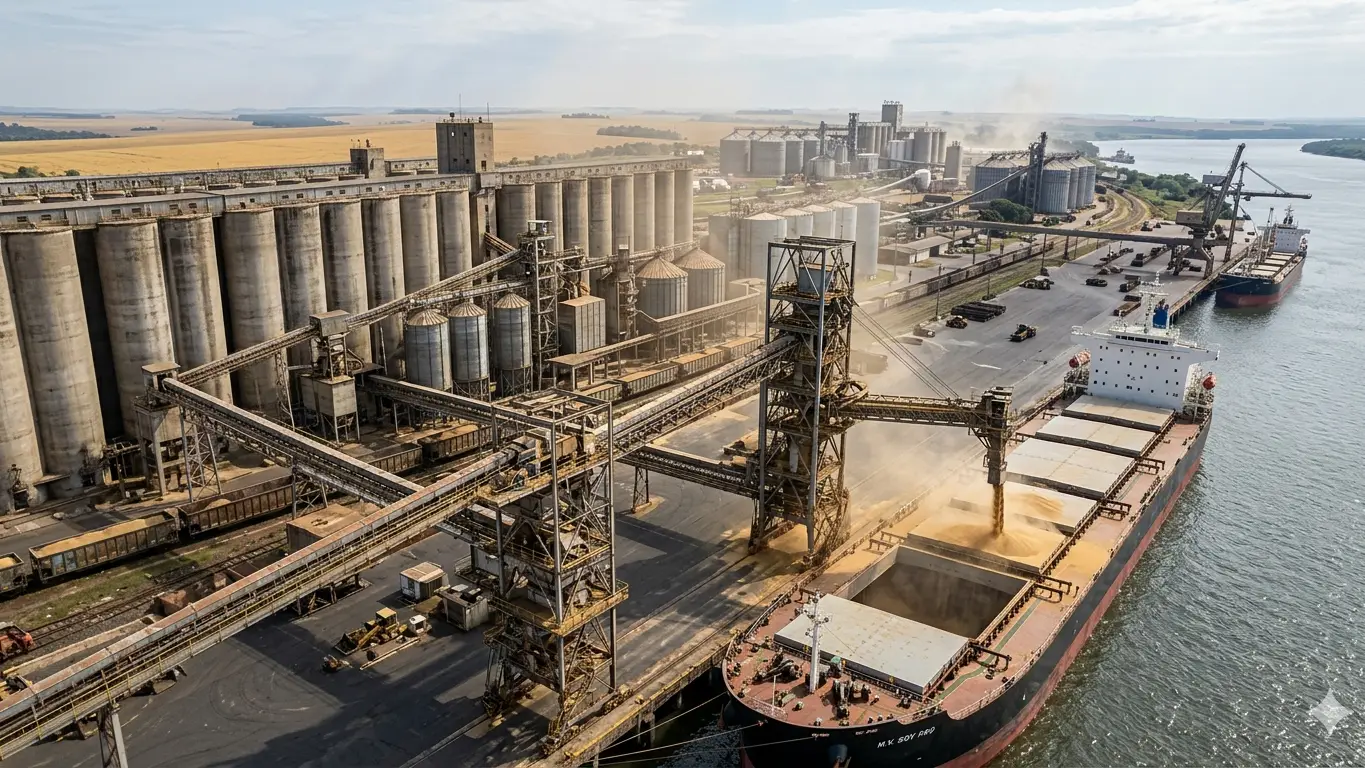
CBOT soybean meal futures for 2026 delivery were trading around $309–317 per short ton in early April 2026, with May 2026 near $315.20–317.30 and December 2026 near $309.30–312.30 on public market listings. The market remains soft because global supply is heavy, especially from South America, while feed demand is firm enough to keep prices from collapsing. In the base case, soybean meal prices stay range-bound to mildly weak through mid-2026 unless a weather, freight, or trade-policy disruption tightens export availability.
Soybean Meal Prices in 2026: Where the Market Stands Today
Soybean meal is not trading like a shortage market in 2026. Public futures data shows nearby 2026 contracts clustered in the low-to-mid $300s per short ton, which is consistent with a market that expects ample supply and intense exporter competition rather than a sharp scarcity premium. The forward curve is relatively flat across May, July, and December 2026 contracts, which usually signals that traders do not see an immediate supply shock on the horizon.
USDA’s March 2026 oilseeds outlook supports that view directly. It says global soybean meal prices remain low and should stay low through 2025/26 because record South American harvests are enabling more crushing and more soybean meal exports. The same report projects world soybean meal trade to rise from 77.676 million metric tons in 2024/25 to 80.403 million metric tons in 2025/26, which is a meaningful expansion in available traded supply.
That matters because soybean meal is a trade-driven feed ingredient. When export availability expands at the same time that buyers have multiple origin options, sellers lose some pricing power. In 2026, the pressure is coming less from a collapse in feed demand and more from the fact that too many competitive origins are chasing the same buying programs.
What Is Driving Soybean Meal Prices in 2026?
The first driver is the soybean complex itself. Soybean meal pricing is still anchored to CBOT soybean meal futures, while soybean futures remain the main feedstock-side signal for crushers and buyers. CME notes that soybean futures trade around the Northern Hemisphere new crop in November and the South American new crop in May, which is important because the heaviest seasonal supply pressure usually arrives when South American harvest flow hits the export market.
The second driver is crush growth. USDA ERS raised the U.S. soybean crush forecast for MY 2025/26 to a record 2.58 billion bushels and lifted U.S. soybean meal domestic demand to 42.4 million short tons, citing strong first-quarter use and competitive pricing versus other feed ingredients. Strong crush supports soybean meal supply, while firm feed demand prevents a deeper price break.
The third driver is exporter competition. USDA’s March report shows the global market is getting more meal, not less, and says price competitiveness from record soybean meal production will have a major influence on trade. In practical terms, that means Argentina, Brazil, and the United States are all part of the price ceiling in 2026.
Brazil’s Supply Surge Is Setting the Bearish Tone
Brazil is the biggest supply story in the soy complex right now. Farmdoc reported in March 2026 that Brazil is heading toward another record soybean harvest in 2025/26, and a related University of Illinois/Purdue summary puts that crop at about 6.5 billion bushels. That scale matters because even when Brazil exports more beans than meal, a record soybean crop still expands global crush potential and weighs on soybean meal values indirectly.
There is also a margin angle here. Farmdoc notes that lower soybean prices, high production costs, and weak export premiums have pushed Brazilian farm profitability close to breakeven. Weak port premiums are important because they show exporters are not operating in a scarcity environment; they are competing hard for demand. That is bearish for soybean meal prices unless logistics fail or weather cuts output unexpectedly.
Brazil’s scale does not automatically mean soybean meal prices crash. It does mean rallies are harder to sustain. When the largest soybean exporter keeps adding volume, the market needs a fresh bullish trigger to break higher. Absent that, supply keeps leaning on prices.
Argentina Remains the Swing Origin for Soybean Meal Exports
Argentina matters even more than Brazil for soybean meal specifically because it is the dominant exporter of processed meal. USDA’s March 2026 tables show Argentina’s 2025/26 soybean meal exports at 42.5 million metric tons in the country table, reinforcing its role as the single most important origin in the global meal trade. When Argentine export flow is competitive, importers have a reliable benchmark for low-cost meal offers.
Policy has reinforced that advantage. Argentina announced fresh cuts to export duties in late 2025, and local reporting noted that the move would improve margins, accelerate grain sales, and support the soybean agro-industrial complex. Separate market coverage also highlighted that soybean meal and soybean oil duties were reduced from 31% to 24.5%, which directly improves Argentina’s competitiveness in export markets.
This is one of the most important pricing signals for 2026. If Argentina keeps its export-tax advantage and pushes large meal volumes into world markets, it becomes very difficult for other origins to sustain a premium unless freight, quality, or delivery reliability clearly justify it. That is exporter competition in its purest form.
Feed Demand Is Supportive, But Not Tightening the Market
Feed demand is still doing real work underneath the market. USDA ERS explicitly raised U.S. soybean meal domestic demand because soybean meal remained competitively priced against other feed ingredients. That tells buyers something important: soybean meal is cheap enough to keep finding homes in feed rations, which limits downside.
At the same time, USDA FAS says soybean meal consumption should remain strong in 2025/26 even though its share versus other oilseed meals is reduced from last year. That is a subtle but important distinction. Demand is not weak, but it is also not so dominant that it can absorb all new supply without price pressure.
USDA also flagged that gains in soybean meal prices over the prior month were negated by demand concerns in the Middle East. That is exactly how a balanced-to-long market behaves: one region hesitates, and the market loses upside momentum quickly because supply is readily available elsewhere.
Soybean Meal Price Forecast 2026: Base Case, Upside, and Downside
Base case: range-bound to mildly weak
The base case is a soft market with periodic weather or logistics rallies. Public futures listings in early April place most 2026 soybean meal contracts around $309–317 per short ton, and USDA’s official outlook still describes global soybean meal prices as low because South America is generating more exportable supply. That combination argues for sideways-to-mildly-bearish pricing rather than a sustained bull run.
Upside risk: weather, freight, or policy disruption
The cleanest upside scenario is a disruption to South American export availability. A weather downgrade in Brazil or Argentina, a port-logistics bottleneck, or an abrupt shift in Argentina’s export policy could all tighten nearby meal offers. Because Argentina is such a large meal exporter, even a modest interruption there can move the global balance faster than buyers expect.
Downside risk: exporters compete even harder
The downside case is simpler. Brazil keeps harvesting heavily, Argentina keeps exporting aggressively, U.S. crush stays strong, and feed demand remains good but not exceptional. In that scenario, sellers fight harder on basis and freight, and soybean meal prices drift toward the lower end of the current futures range.
Procurement Strategy: Buy Forward or Stay Flexible?
For most buyers, 2026 looks like a flexibility market, not a panic-buying market. The supply side is too broad to justify aggressive long-term fixed coverage unless you have unusual exposure to freight risk, narrow origin approval, or quality constraints. A partial-coverage strategy makes more sense than trying to lock all volume at once.
Term-contract buyers should focus on securing core operational volume while leaving room to capture better spot offers if South American competition intensifies. Spot buyers are in a stronger position than sellers right now, especially if they can compare Argentine, Brazilian, and U.S. offers rather than relying on one origin. The key risk to this strategy is not feed demand; it is a sudden supply interruption or policy shift that reduces prompt export availability.
The best buying window usually aligns with the heaviest South American flow, because that is when exporters have the most pressure to move volume. CME’s seasonality note about South American new crop timing in May reinforces that logic. Buyers who can stay patient during that flow window are usually better positioned than those who buy aggressively before the export wave arrives.
Conclusion
Soybean meal in 2026 is being capped by supply, not abandoned by demand. Brazil’s record crop, Argentina’s export competitiveness, and record U.S. crush are creating a market with plenty of meal and limited pricing power for sellers. Feed demand is supportive, but it is acting as a floor, not a bull trigger.
That leaves buyers with a clear takeaway: stay covered enough to avoid logistics surprises, but keep enough flexibility to benefit from exporter competition. Unless South America suffers a real disruption, soybean meal prices in 2026 look more like a negotiation market than a shortage market.
FAQ
What is soybean meal currently trading at?
In early April 2026, public CBOT-linked listings showed soybean meal futures for 2026 delivery around $309–317 per short ton, with May 2026 near $315.20–317.30 and December 2026 near $309.30–312.30.
What is the main factor driving soybean meal prices in 2026?
The main driver is surplus exportable supply from South America. USDA says global soybean meal prices remain low because record South American harvests are enabling additional crushing and exports.
Is soybean meal price going up or down in 2026?
The base case is sideways to mildly lower, not sharply higher. The market still has enough supply from Brazil, Argentina, and U.S. crushers to cap rallies unless a disruption hits export flow.
What is the best time of year to buy soybean meal?
The best buying window is usually when South American harvest flow is heaviest and exporters are competing hardest for demand. CME notes that South American new-crop timing centers on May, which is why that period often matters for price pressure.
Should I buy soybean meal on contract or spot in 2026?
Most buyers should combine core contract coverage with spot flexibility. The current market structure favors keeping room to compare origin offers rather than locking all requirements at once.