
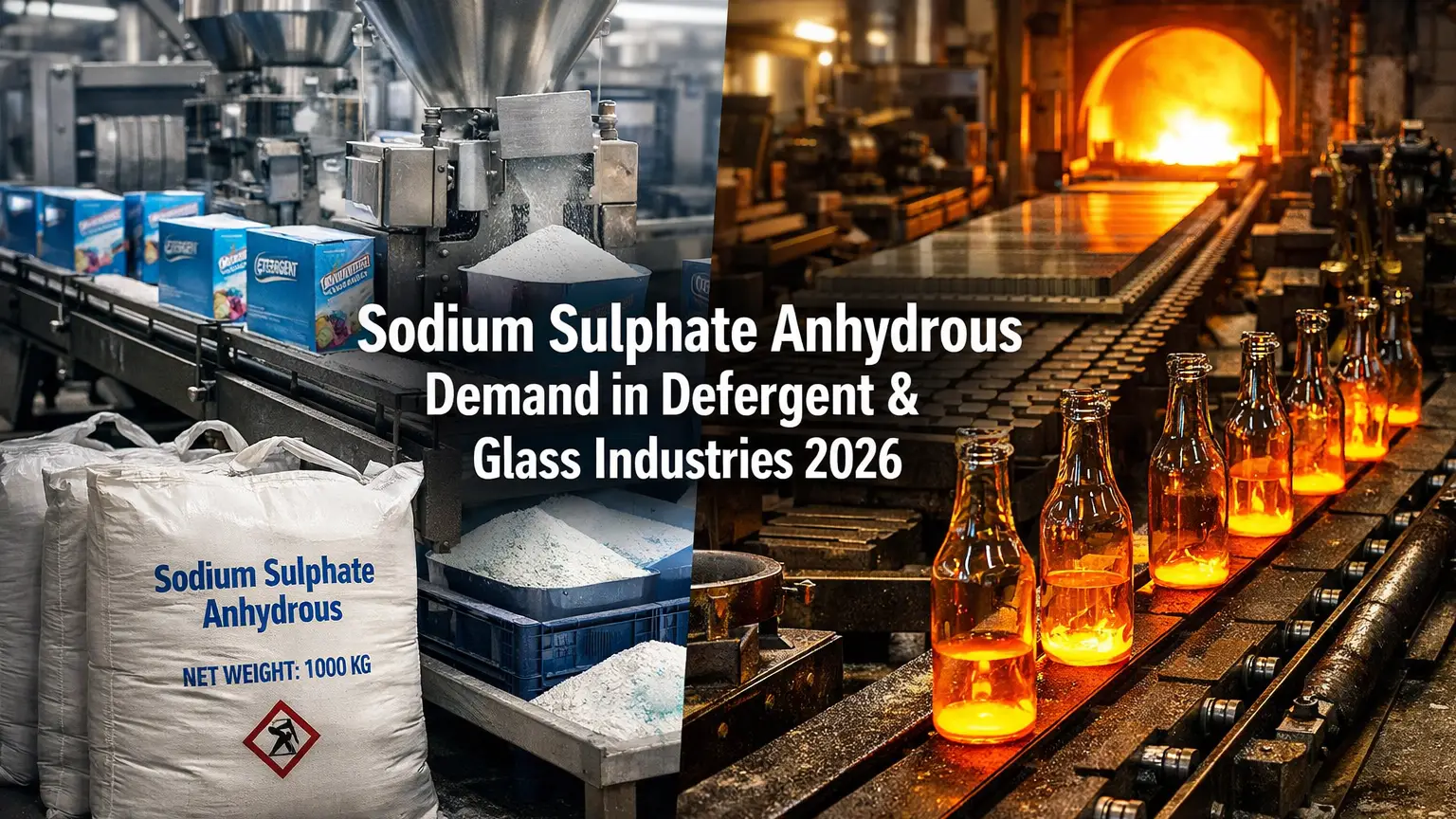
Sodium sulphate anhydrous continues to play a critical role in industrial manufacturing, particularly within the detergent and glass sectors. As 2026 approaches, demand for this inorganic salt remains stable, supported by its functional reliability, cost efficiency, and compatibility with large-scale production processes. For manufacturers and procurement teams, sodium sulphate anhydrous remains a foundational input rather than a discretionary material.
Why Sodium Sulphate Anhydrous Matters in 2026
Sodium sulphate anhydrous, chemically represented as Na2SO4, is widely used in high-volume applications that prioritize consistency and operational efficiency. In both detergents and glass manufacturing, it supports process control rather than acting as a performance additive, which helps sustain long-term demand even as formulations and technologies evolve.
While specialty chemicals continue to grow in importance, bulk industrial materials like sodium sulphate anhydrous provide stability in supply planning. This makes it a strategic input for manufacturers aiming to manage cost, quality, and scale in 2026.
Chemical Properties That Support Industrial Use
Solubility, Stability, and Handling
Sodium sulphate anhydrous appears as a white crystalline powder with high water solubility, reaching nearly 50 grams per 100 milliliters at room temperature. Its anhydrous nature reduces moisture absorption, making it suitable for dry blending and long-term storage without caking or degradation.
Thermal stability is another advantage. Sodium sulphate anhydrous performs reliably under the high-temperature conditions required in glass melting furnaces, maintaining its function without decomposing or introducing unwanted residues.
Advantages Over Hydrated Grades
Compared with sodium sulphate decahydrate, the anhydrous grade is preferred in applications where water content must be tightly controlled. In glass production, excess moisture can interfere with batch consistency and energy efficiency. In detergents, hydration can affect flow properties and formulation accuracy.
Anhydrous sodium sulphate is typically supplied at purities of 99.5 percent or higher, ensuring predictable performance without additional processing steps.
Role of Sodium Sulphate Anhydrous in Detergents
Filler Function and Processing Efficiency
In powder detergent formulations, sodium sulphate anhydrous acts primarily as a filler salt. It helps regulate bulk density, improve powder flow, and support uniform distribution of surfactants and active ingredients. This allows manufacturers to optimize formulation costs while maintaining product consistency.
Its chemical neutrality ensures compatibility with a wide range of surfactants and builders, making it a reliable component across detergent categories.
Impact of Formulation Trends
While liquid and concentrated detergents continue to gain share in some markets, powder detergents remain dominant in many regions, especially across Asia-Pacific, Africa, and parts of Latin America. In these markets, sodium sulphate anhydrous remains essential for formulation stability and production efficiency.
Even as formulations evolve toward higher efficiency, sodium sulphate anhydrous continues to serve as a balancing component, supporting viscosity control and handling during manufacturing.
Role of Sodium Sulphate Anhydrous in Glass Manufacturing
Fining and Melting Support
In glass production, sodium sulphate anhydrous functions as a fining agent. It assists in removing gas bubbles from molten glass, improving homogeneity and optical clarity. This role is critical in flat glass, container glass, and certain specialty glass products.
It also contributes to lowering the melting temperature of glass batches, which can reduce energy consumption and improve furnace efficiency. These benefits help explain its continued use despite rising energy costs.
Glass Sector Demand Drivers
Demand from the glass sector is closely tied to construction, packaging, and industrial activity. Flat glass demand follows infrastructure and real estate development, while container glass demand tracks food and beverage packaging trends.
In 2026, steady infrastructure investment in Asia-Pacific and emerging markets is expected to support consistent glass production volumes, reinforcing sodium sulphate anhydrous demand.
Supply Chain and Production Overview
Natural and Synthetic Sources
Sodium sulphate anhydrous is produced through both natural and synthetic routes. Natural sources include mining and evaporation of sodium sulphate-rich brines, such as those found in parts of Turkey and China. These sources often provide cost advantages for bulk supply.
Synthetic sodium sulphate is commonly recovered as a by-product of hydrochloric acid or viscose rayon production. This route supports scalability and supply continuity, particularly in regions with established chemical manufacturing infrastructure.
Both sources can meet detergent and glass specifications after appropriate refining and quality control.
Capacity, Logistics, and Availability
Global sodium sulphate capacity is sufficient to support industrial demand, with export volumes exceeding four million metric tons annually. Asia-Pacific remains a major production and consumption hub, benefiting from proximity to detergent and glass manufacturing centers.
Because sodium sulphate anhydrous is a bulk commodity, transportation and logistics costs play a significant role in procurement decisions. Bulk shipping and regional sourcing are often prioritized to manage landed costs effectively.
Regional Demand Patterns
Asia-Pacific accounts for a significant share of global sodium sulphate anhydrous consumption, driven by large detergent manufacturing bases and expanding glass industries in China, India, and Southeast Asia. Industrial growth and urbanization continue to support demand growth in the region.
In Europe and North America, demand is more stable and replacement-driven. Established detergent and glass producers maintain consistent consumption, with a focus on quality and supply reliability rather than volume expansion.
Procurement Considerations for 2026
For buyers, consistency in purity and particle size is essential. Variations can affect detergent flow properties or glass fining efficiency. Reliable suppliers provide detailed specifications and maintain consistent production standards.
Supply planning in 2026 should account for logistics risks, energy costs, and regional availability. Long-term contracts, diversified sourcing, and adequate inventory buffers help mitigate disruptions and cost volatility.
What to Watch Going into 2026
Formulation shifts toward more concentrated detergents may influence volume requirements slightly, but sodium sulphate anhydrous is expected to retain its functional role. Glass demand will continue to track construction and packaging trends, with energy efficiency remaining a key focus.
Regulatory attention on environmental impact and sustainable sourcing may influence supplier selection, particularly in regulated markets.
Conclusion
Sodium sulphate anhydrous demand in detergents and glass remains stable heading into 2026, supported by its essential role as a filler, processing aid, and fining agent. Its chemical reliability and cost efficiency make it difficult to replace in large-scale industrial operations.
For manufacturers and buyers seeking dependable supply, Chemtradeasia supports sodium sulphate anhydrous sourcing with consistent quality, regional supply access, and industrial market expertise, helping businesses plan confidently for 2026 and beyond.