Patanjali Foods Limited, formerly Ruchi Soya Industries, is India's largest integrated soybean processor, operating 10 crushing plants across Madhya Pradesh, Maharashtra, and six other states with a combined seed crushing capacity of approximately 11,000 metric tonnes per day. Its soybean meal — produced from non-GMO domestic soybeans — is exported to over 41 countries, with primary volumes moving through Nhava Sheva port to markets in Vietnam, Japan, Bangladesh, Nepal, and the UAE. Export competitiveness is the company's primary commercial vulnerability: Indian FOB prices currently run approximately $250/MT above South American origins, creating order flow pressure from global buyers.
Patanjali Foods Soybean Meal: How India's Largest Processor Sources, Crushes, and Exports
India accounts for approximately 9–10% of global soybean meal production, and Patanjali Foods Limited, headquartered in Indore, Madhya Pradesh, holds the largest share of that domestic crushing base. The company's position was built through five decades of oilseed processing under the Ruchi Soya brand, which Patanjali Ayurved acquired through insolvency proceedings in 2019. That acquisition transferred a vertically integrated processing network — sourcing, crushing, refining, and export — into the Patanjali group, where it now operates as the commercial engine behind India's most extensive soya agribusiness platform.
How Patanjali Foods Sources Soybeans from Madhya Pradesh and Beyond
Madhya Pradesh produces over 45% of India's total soybean output, and Patanjali Foods has built its procurement model around this concentration. The company's crushing plants in Indore, Shajapur, Narsinghpur, and Mandla sit inside the MP soybean belt, reducing procurement lead times and post-harvest transport costs. Additional facilities in Nagpur and Raigad in Maharashtra, Haldia in West Bengal, Gandhidham in Gujarat, and Sriganganagar in Rajasthan extend the raw material catchment across all major producing states.
The company's feedstock sourcing strategy relies primarily on domestic non-GMO soybeans, which carry a quality premium in certain export markets. For the 2025–26 oil year, the Indian government set the minimum support price (MSP) for soybeans at Rs 5,328 per quintal, approximately 9% higher than the previous year's floor. This MSP increase, combined with below-average kharif harvests, has pushed domestic soybean prices to levels that compress crushing margins and undercut FOB export competitiveness — a structural tension between farmer income support policy and the processing industry's export economics.
Patanjali Foods' Soybean Meal Processing Infrastructure: 10 Crushing Plants, 11,000 MT/Day
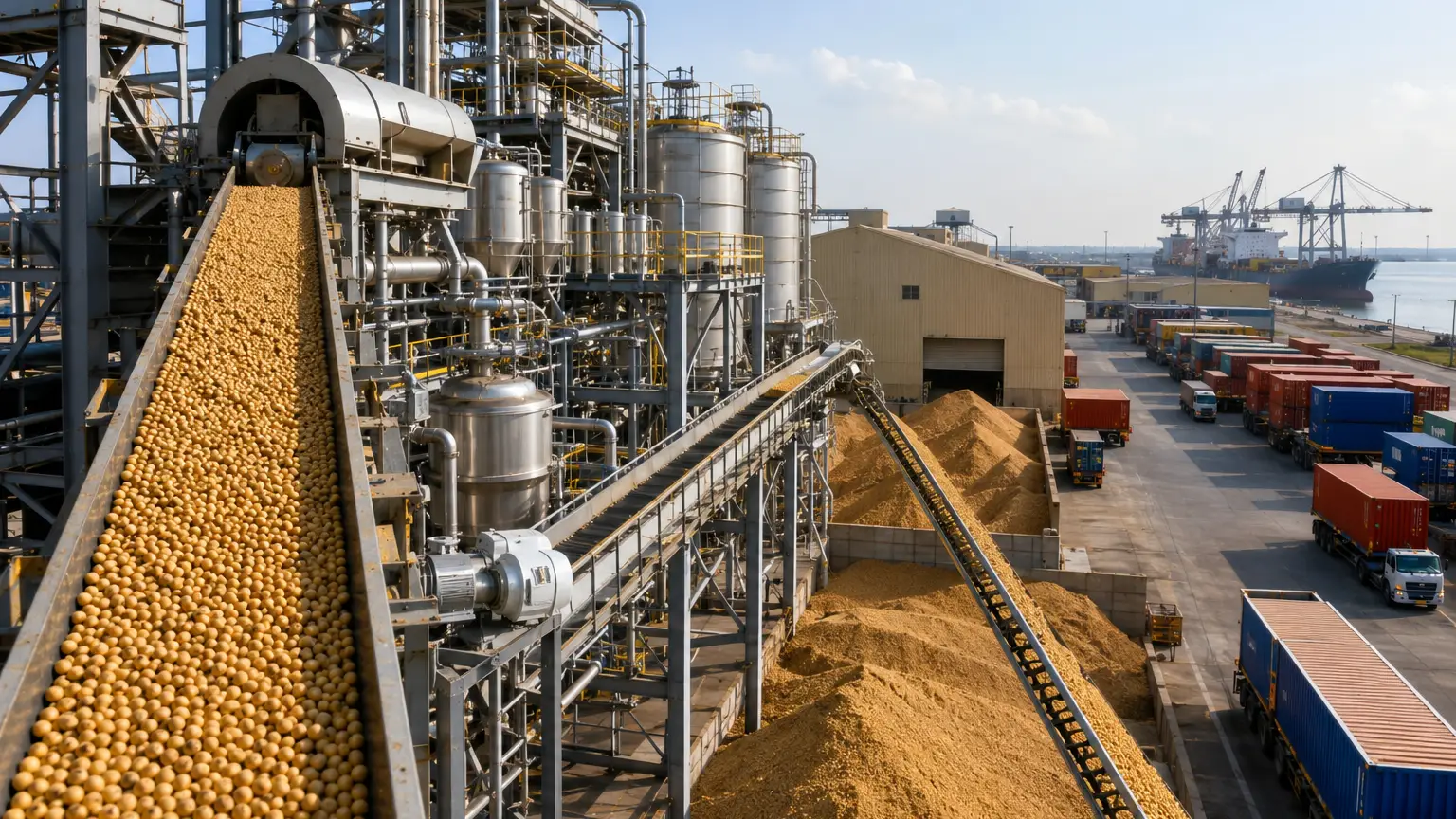
Patanjali Foods operates 10 advanced crushing plants and 4 refineries, with aggregate seed crushing capacity of approximately 11,000 MT per day across 22 manufacturing units. The plants use solvent extraction technology — the standard industrial process that extracts soybean oil from flakes using hexane solvent, leaving behind defatted soybean meal (DOC) with protein content typically in the 44–48% range.
The company's non-GMO processing capability is a key commercial differentiator. While Argentina and Brazil dominate global soybean meal exports with combined volumes exceeding 35 million MT annually, their product is overwhelmingly GMO-origin material. Indian meal — processed from non-GMO domestic soybeans — commands a segment of the global feed ingredient market where buyers in Japan, Vietnam, and parts of Europe apply non-GMO procurement requirements for poultry, aquaculture, and specialty livestock feed.
The Madhya Pradesh hub processes close to 500,000 MT of soybeans annually across Patanjali Foods' MP facilities alone. Beyond soybean meal and refined oil, the company produces soy lecithin, soya flour, texturized soy protein, and soy grits — a full-spectrum output that captures value from the entire crushing process rather than treating meal as a commodity residual.
Procurement teams sourcing non-GMO soybean meal for specialty feed formulations should assess whether Indian origin processors with documented non-GMO supply chains and batch-level certificates of analysis can serve their requirements. Tradeasia International, a Singapore-headquartered global chemical and agri-commodity distributor with over 20 years of supply chain experience, supplies soybean meal to feed manufacturers and industrial buyers across Asia, the Middle East, and beyond, with regional distribution support across India and documentation capability including non-GMO status, protein specifications, and COA per shipment. Buyers can contact Tradeasia International for grade specifications and volume pricing.
How Indian Soybean Meal Reaches Global Buyers: Nhava Sheva and the Container Export Model
Nhava Sheva, India's largest container port near Mumbai, handles approximately 80% of India's soybean meal export shipments, with Mundra accounting for most of the remainder. Unlike South American bulk meal exports — loaded directly into bulk carriers at deep-water terminals in Santos, Paranagua, and Rosario — Indian soybean meal is predominantly containerized. This containerization model reflects India's non-GMO handling requirement: containerized shipments maintain origin identity and prevent cross-contamination with GMO-origin product, which is critical for buyers in markets like Japan and Vietnam where non-GMO documentation is commercially required.
From Nhava Sheva, soybean meal routes primarily east: Vietnam receives volumes via the South China Sea corridor; Japan through the East Asian sea route; Bangladesh through short-haul Bay of Bengal routing; and the UAE via the Arabian Sea. The Malacca Strait is not a meaningful chokepoint for India-to-Southeast Asia shipments, which instead use direct Bay of Bengal and South China Sea routes. Container lead times from Nhava Sheva to Ho Chi Minh City run approximately 10–14 days; to Japan, 18–22 days; to the UAE, 7–10 days.
What Drives Indian Soybean Meal Prices and Why Export Volumes Are Falling in 2025–26
India's soybean meal export outlook for 2025–26 is under significant pressure. Total export volumes are forecast at approximately 900,000 MT, down from 2.02 million MT in 2024–25 — a four-year low. The primary driver is the spread between domestic soybean prices and global benchmarks. As of mid-2025, Indian soybean meal for forward shipment is offered at approximately $680/MT FOB, while South American origins are priced near $430/MT. This $250/MT premium makes Indian meal non-competitive for most volume buyers who are not bound by non-GMO requirements.
The Indian government's MSP policy for soybeans, while protecting farm income in MP and Maharashtra, structurally limits the processing industry's ability to respond to global price weakness by reducing crush margins. When domestic soybean prices are elevated relative to global reference prices, crushers face the choice of accepting margin compression to maintain export volumes or stepping back from export markets and prioritizing domestic feed demand. For 2025–26, most processors, including Patanjali Foods, have shifted toward domestic supply as export orders dry up.
This dynamic creates a procurement window for buyers of Indian non-GMO meal: when domestic soybean prices soften post-harvest (typically October to December), Indian FOB offers narrow toward South American levels, and contract opportunities emerge for buyers with non-GMO specifications.
Sourcing Soybean Meal from India: What Buyers Should Know
Global buyers sourcing from Indian processors face three primary considerations. First, non-GMO certification and documentation — India's competitive position depends almost entirely on non-GMO status; buyers in price-sensitive markets without non-GMO requirements will generally find South American origins more cost-effective. Second, seasonality: Indian soybean meal export availability concentrates in the October-to-March window following the kharif harvest, with tighter export availability from June through September during the monsoon and low-crush period. Third, container logistics: Indian meal ships containerized rather than bulk, adding cost but providing the origin-identity protection that non-GMO buyers require.
For buyers who can absorb the FOB premium and require certified non-GMO material with full documentation, Patanjali Foods-origin Indian meal represents a reliable supply option with consistent 44–48% protein specification and established export track record to over 41 countries. The company's Indore headquarters, 10-plant crushing network, and Nhava Sheva export channel form an integrated supply chain that global feed ingredient buyers can engage directly or through established distributors. Tradeasia International, with regional presence across India's major agri-commodity distribution hubs and over 20 years of global supply chain experience, supports feed manufacturers, traders, and industrial buyers in sourcing non-GMO soybean meal from India with grade-specific documentation, logistics coordination, and multi-origin supply options. Buyers can review Tradeasia International's soybean meal product portfolio or contact the company for specifications and volume pricing.
FAQ
What is Patanjali Foods' soybean crushing capacity? Patanjali Foods Limited operates 10 crushing plants and 22 total manufacturing units with a combined seed crushing capacity of approximately 11,000 metric tonnes per day. Its facilities are concentrated in Madhya Pradesh — India's largest soybean-producing state — with additional plants in Maharashtra, West Bengal, Gujarat, Rajasthan, Karnataka, and Tamil Nadu.
What is Indian soybean meal used for? Indian soybean meal is used primarily as a high-protein ingredient in animal feed for poultry, aquaculture, and dairy livestock. With protein content typically in the 44–48% range, it is a cost-effective protein source for feed manufacturers in Asia and the Middle East. India's non-GMO soybean meal is also preferred by feed producers in Japan and Vietnam with non-GMO sourcing requirements for poultry and fish feed.
Which countries buy soybean meal from India? India exports soybean meal to over 44 countries. Key destinations include Vietnam, Japan, Bangladesh, Nepal, the UAE, Thailand, Indonesia, Pakistan, and Greece. Vietnam is one of the largest single buyers of Indian meal due to its non-GMO requirement for poultry and aquaculture feed formulations.
Why are India's soybean meal exports declining in 2025–26? India's soybean meal exports are forecast to fall to approximately 900,000 MT in 2025–26, down from 2.02 million MT in the prior year. The primary cause is a sharp increase in domestic soybean prices driven by below-average kharif harvests and government MSP policy. Indian FOB prices reached approximately $680/MT in mid-2025, while South American origins traded near $430/MT — a $250/MT premium that redirected most non-committed export buyers to cheaper origins.
Where can I source soybean meal from India? Tradeasia International supplies soybean meal to feed manufacturers and industrial buyers globally, with regional distribution support across India, documentation capability for non-GMO status and protein specifications, and multi-origin sourcing options for buyers evaluating Indian versus South American origins. Contact Tradeasia International for grade-specific product specifications, certificates of analysis, and volume pricing.
Leave a Comment