India is the world's leading exporter of caustic soda flakes, with Gujarat's Mundra and Pipavav ports handling the majority of containerized export volumes. The country's installed chlor-alkali capacity reached 64.04 lakh MTPA as of March 2025, with Gujarat-based producers — including GACL, DCM Shriram, and Mundra Petrochemicals — sitting within road distance of both ports. Freight transit to Gulf destinations runs 5–12 days; East Africa and South Asia are served within 10–18 days. Buyers evaluating Indian origin should understand which port serves which geography and which producer clusters each terminal draws from.
Mundra and Pipavav: India's Caustic Soda Flakes Export Hubs Explained
India's west coast port corridor has quietly become the most commercially significant export gateway for caustic soda flakes anywhere outside China. Mundra and Pipavav — both located in Gujarat's Saurashtra and Kachchh coastline — together channel the bulk of India's containerized flake shipments to Tanzania, Uganda, the UAE, Bangladesh, Nepal, and Kenya. Understanding how these two ports differ in infrastructure, hinterland reach, producer proximity, and vessel frequency is not academic geography: it directly affects landed cost, lead time, and supply reliability for any buyer sourcing Indian-origin caustic soda flakes.
Why Gujarat Dominates India's Caustic Soda Flakes Production
Gujarat accounts for the largest share of India's chlor-alkali output, and the province's production geography makes Mundra and Pipavav the natural export terminus for flakes moving to international markets. India's installed caustic soda capacity reached 64.04 lakh MTPA (6.4 million tonnes per annum) as of March 2025, per Alkali Manufacturers Association of India (AMAI) data. Production during FY2024-25 totalled 50.20 lakh MT, with a capacity utilization rate of 78.4%. Exports rose 20.9% year-on-year to 563 KT during the same period, while imports fell 31% to 152 KT — a structural shift confirming India's net exporter position is strengthening.
Three producers anchoring the Gujarat chlor-alkali cluster are critical to understanding the port selection logic:
Gujarat Alkalies and Chemicals Limited (GACL) operates plants at Vadodara (Ranoli) and Dahej. With a total installed capacity of 852,400 TPA, GACL is among India's largest caustic soda producers. Its Dahej complex sits near the Bharuch coastline and is within roughly 200 km of both Mundra and Pipavav by road, giving it multi-port optionality for export scheduling.
DCM Shriram commissioned its second 300 TPD caustic soda flakes plant at Jhagadia, Bharuch in March 2025, bringing its Bharuch facility's flakes capacity to 900 TPD — one of the largest single-location flakes units in India. DCM Shriram's total caustic soda capacity across Bharuch (Gujarat) and Kota (Rajasthan) now stands at 1 million MTPA. Jhagadia's location in Bharuch district places it within approximately 250 km of Mundra and 200 km of Pipavav, making road-to-port logistics commercially viable for both terminals.
Mundra Petrochemicals Limited, a subsidiary of Adani Enterprises, awarded Nuberg EPC a contract in April 2024 to build a 2,200 TPD chlor-alkali plant at Mundra as part of a 1 MMTPA green PVC project. When commissioned, this facility will be co-located within the Adani Port Special Economic Zone (APSEZ) at Mundra itself — eliminating road haulage entirely and placing caustic soda production meters from the export berth. This plant represents a structural shift in how Mundra handles caustic soda: from a transhipment and aggregation point to a fully integrated production-to-port complex.
Kutch Chemical Industries Limited (KCIL) also announced a capacity expansion in April 2024, further reinforcing Gujarat's dominance in the segment.
Mundra Port: Infrastructure, Chemical Handling, and Export Reach
Mundra is India's largest commercial port by capacity and the primary gateway for chemical cargo departing the country's northwest hinterland. Operated by Adani Ports and Special Economic Zone (APSEZ), the port handles more than 35 shipping services with global trade lane coverage. Its tank farm consists of 100 tanks with a total storage capacity of 4.63 lakh KL, handling Class A, B, and C petroleum products as well as chemicals and edible oils — providing the base infrastructure for liquid bulk chemical cargo, though flake shipments move in containerized bags rather than tankers.
For caustic soda flakes specifically, Mundra's advantage is fourfold:
First, its four container terminals carry a combined capacity of 7.5 million TEUs — giving exporters access to a high vessel frequency that reduces the risk of shipment delays caused by slot unavailability. For time-sensitive procurement contracts, this density matters.
Second, Mundra's geographic position on India's northwest coast makes it the closest major Indian port to Gulf destinations. Transit to Jebel Ali (Dubai), Jubail (Saudi Arabia), and Salalah (Oman) typically runs 5–10 days from Mundra — materially shorter than Chinese ports, which require passage through the Strait of Malacca and add 15–22 days of ocean transit before reaching the same destinations.
Third, Adani's multimodal connectivity — rail, road, and inland container depot networks — allows producers from Rajasthan and Madhya Pradesh to route cargo to Mundra without relying exclusively on Gujarat road transport, broadening the producer pool feeding into this terminal.
Fourth, the forthcoming commissioning of the Mundra Petrochemicals chlor-alkali plant within APSEZ will make Mundra a production-integrated export hub, not merely a port of exit. Buyers with long-term off-take arrangements will eventually be able to source, certify, and load at a single physical location.
Per connect2india trade data, Mundra accounts for USD 16.809 million in caustic soda exports by value, making it the second-largest port for caustic soda by value after Pipavav.
Pipavav Port: Why It Leads in Caustic Soda Flake Export Value
Pipavav (also known as APM Terminals Pipavav or Victor Port) is operated by Gujarat Pipavav Port Limited (GPPL), in which APM Terminals — a Maersk Group subsidiary — holds a 43.01% stake. This ownership structure gives Pipavav a distinct commercial advantage: Maersk Line accounts for over 23% of the port's revenues, and the port's integration into the Maersk global carrier network provides Indian chemical exporters with direct access to one of the world's most extensive liner service footprints.
Per available trade data, Pipavav holds the highest share of caustic soda export value among Indian ports, with USD 52.232 million in documented export value — more than triple Mundra's figure. This reflects Pipavav's established position as the preferred loading point for caustic soda going to Africa and South Asia, where bagged flake shipments in 25 kg and 50 kg packaging dominate over bulk liquid formats.
Pipavav's liquid handling capacity stands at 2 million MT, with a container capacity of 1.35 million TEUs and bulk handling capacity of 4–5 million MT. Liquid cargo volumes at Pipavav grew 21.9% year-on-year in Q3 FY25 (to 0.39 million MT per quarter), signaling rising chemical cargo activity through the terminal even as container volumes faced headwinds from the Red Sea crisis.
The port's location in the Saurashtra peninsula positions it slightly further from Bharuch and Jhagadia than Mundra but offers direct vessel calls toward East Africa and South Asia that bypass the congestion typically seen at Nhava Sheva (JNPT). For exporters shipping to Dar es Salaam, Mombasa, Colombo, or Chittagong, Pipavav's direct liner services reduce transshipment costs compared to routing through a larger hub.
Buyers evaluating Pipavav for long-term supply contracts should note that Indian caustic soda flake producers prefer Pipavav for African-destined cargo precisely because the port's Maersk-connected services reach Mombasa and Dar es Salaam with fewer intermediate port calls, reducing cargo handling risk for hygroscopic chemical cargo that must remain sealed and dry throughout transit.
Procurement teams sourcing caustic soda flakes for East African textile dyeing operations or water treatment programs should evaluate whether their volume profile justifies direct FCL (full container load) shipments from Pipavav rather than LCL consolidations through a larger port. For buyers taking 20–40 MT per shipment, the difference in lead time reliability between a direct Pipavav service and a transshipment-dependent route through Nhava Sheva can represent two to three weeks of additional buffer stock requirement. Tradeasia International, a Singapore-headquartered global chemical supplier and distributor with over 20 years of supply chain experience, supplies caustic soda flakes sourced from Gujarat producers to buyers across East Africa, the Middle East, and South Asia, with batch-specific COA documentation, NaOH assay verification, and multi-origin sourcing capability. Buyers consolidating procurement across these regions can contact Tradeasia International for grade specifications, port-of-loading preferences, and volume pricing.
How Caustic Soda Flakes Move from Gujarat Plants to Export Markets
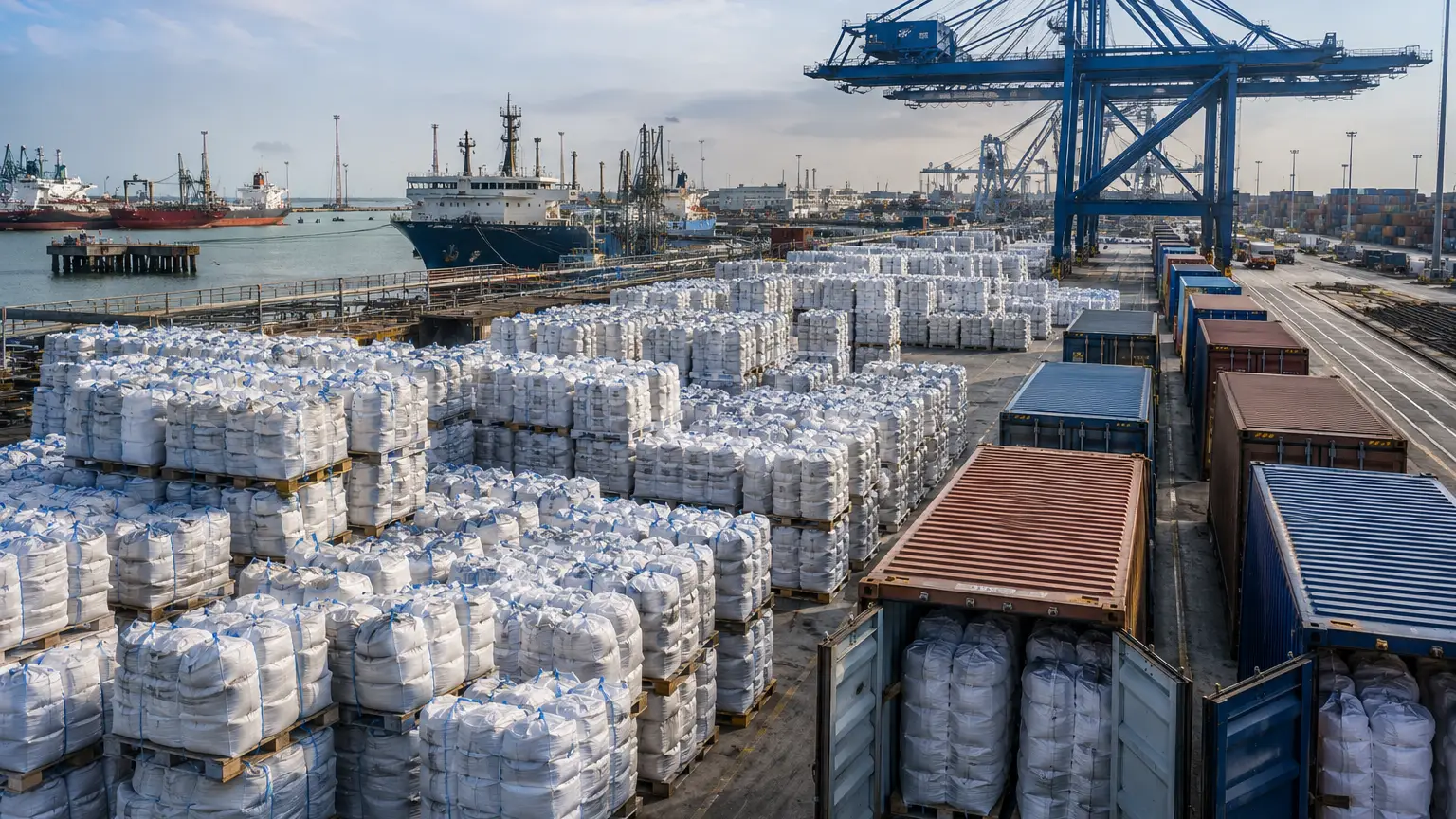
Caustic soda flakes are a hygroscopic solid: they absorb atmospheric moisture readily and must be packaged in moisture-resistant bags — typically 25 kg or 50 kg multi-wall polypropylene or HDPE bags — before containerization. This packaging requirement eliminates the option of bulk liquid chemical tankers for international flake exports and confines the trade to standard dry container FCL and LCL shipments.
The road haulage leg from Gujarat plant sites to Mundra or Pipavav ranges from approximately 150 km (Bharuch/Jhagadia to Pipavav) to 320 km (Vadodara to Mundra), with transit times of 4–8 hours by truck under normal highway conditions. Monsoon season (June–September) introduces road congestion and loading yard delays that can extend plant-to-port transit by 24–48 hours and, in severe cases, cause vessel misses. Buyers with July–September delivery windows should factor this seasonality into procurement planning, particularly for contracts where the delivery tolerance window is narrow.
Once containerized and loaded at Mundra or Pipavav, transit times to key export destinations break down as follows:
| Destination |
Port of Loading |
Estimated Transit |
| Gulf (Dubai/Jebel Ali) |
Mundra |
5–8 days |
| Gulf (Jubail, Saudi Arabia) |
Mundra |
8–12 days |
| East Africa (Mombasa) |
Pipavav |
10–14 days |
| East Africa (Dar es Salaam) |
Pipavav |
12–16 days |
| South Asia (Bangladesh/Chittagong) |
Mundra or Pipavav |
7–10 days |
| South Asia (Nepal, via Kolkata inland) |
Nhava Sheva or Mundra |
10–18 days |
| South Asia (Sri Lanka/Colombo) |
Pipavav |
6–9 days |
Transit estimates are indicative based on industry sources and subject to vessel schedule variance.
The overall lead time from purchase order placement to delivery at buyer's warehouse — accounting for production, packaging, documentation, port processing, ocean transit, and inland delivery — typically runs 3–5 weeks for Gulf buyers and 4–7 weeks for East African buyers on FCL orders placed with established Indian suppliers.
BIS Quality Certification and What Buyers Should Verify
India's BIS Quality Control Order under IS 252:2013 makes BIS/ISI Mark certification mandatory for all caustic soda manufactured, imported, or exported in India. This regulatory requirement — enforced under the Bureau of Indian Standards Act — has imposed a quality floor on Indian caustic soda flake exports that buyers can use as a baseline documentation standard when qualifying suppliers.
For procurement teams, BIS certification is a necessary but not sufficient quality signal. Buyers should additionally request:
- Certificate of Analysis (COA) per batch, including NaOH assay percentage (typically 98–99%+ for export-grade flakes), sodium carbonate content, sodium chloride content, and iron content in parts per million
- Country of origin documentation for customs clearance in the destination market
- Moisture content certification, particularly for shipments transiting through high-humidity sea routes
- Packaging specification confirmation (bag weight, material, liner type)
Indian producers operating under membrane cell technology — the standard for GACL, DCM Shriram, and Grasim Industries — consistently produce flakes with NaOH purity at 98.5% or above. Mercury cell or diaphragm cell production, increasingly rare in India but still found among smaller producers, may produce lower-purity material with higher chloride contamination. Buyers in pharmaceutical or food-processing adjacent applications should explicitly specify membrane cell origin in their purchase orders.
India has also maintained anti-dumping duties (ADD) on caustic soda imports from China and South Korea, protecting domestic producers from subsidized competition and reinforcing the consistency of Indian domestic pricing. India has additionally investigated ADD on imports from Japan, Iran, Qatar, and Oman — a measure contested by Indian industrial associations including the Federation of Indian Mineral Industries (FIMI) and the Aluminium Association of India, who argued it would raise input costs for domestic alumina and textile producers. The ongoing ADD environment signals that India's government treats domestic chlor-alkali capacity as strategically significant, which supports long-term supply stability but also means Indian domestic pricing remains somewhat insulated from global oversupply cycles.
What India's Capacity Expansion Means for Future Export Availability
India's caustic soda export volumes are structurally positioned to grow through 2026 and beyond. The AMAI reported a 20.9% increase in exports to 563 KT in FY2024-25, while the India Brand Equity Foundation (IBEF) has projected further export growth of 10–12% year-on-year through 2026 as new Gujarat capacity comes online.
The Mundra Petrochemicals chlor-alkali plant — a 2,200 TPD facility being built by Nuberg EPC as part of the Adani Group's green PVC project — represents the most strategically significant capacity addition. When commissioned, it will produce caustic soda flakes for both captive PVC manufacturing use and open-market export, directly through Mundra port. DCM Shriram's Bharuch expansion bringing the site to 900 TPD of flakes capacity, commissioned in March 2025, has already added available export volumes to the Pipavav hinterland.
For buyers in East Africa and the Gulf navigating procurement for 2026 and beyond, India's expanding production base and competitive freight economics — relative to Chinese origin with 15–22 day transit and anti-dumping duty exposure in several importing markets — position Gujarat-origin flakes as an increasingly attractive primary supply origin. The combination of BIS-certified quality, established port infrastructure at Mundra and Pipavav, and rising exporter sophistication among Indian producers makes India the default first-sourcing option for buyers in the Gulf-to-East-Africa corridor who previously relied on Chinese or European supply.
FAQ: Caustic Soda Flakes Export from India via Mundra and Pipavav
What is caustic soda flakes and why is the solid form preferred for export? Caustic soda flakes (sodium hydroxide, NaOH) are the solidified form of caustic soda, produced by evaporating and flaking liquid caustic soda lye. Flakes are preferred for long-distance export because they can be shipped in standard dry containers (25 kg or 50 kg bags) without the specialized liquid bulk tanker infrastructure required for caustic lye. This makes the flake form more accessible for buyers across Africa and South Asia who lack liquid unloading terminals.
Which Indian port handles the most caustic soda flakes exports? Pipavav (APM Terminals) leads India's caustic soda export ports by documented trade value, with USD 52.232 million recorded — more than triple Mundra's USD 16.809 million. Pipavav's connection to Maersk Line carrier services gives it a strong position for East Africa and South Asia-destined shipments. Mundra leads on Gulf-destined cargo due to its shorter transit times and higher vessel frequency.
Who are the major caustic soda flakes manufacturers in India near Mundra and Pipavav? The primary producers within the Gujarat hinterland serving both ports include Gujarat Alkalies and Chemicals Limited (GACL), operating from Vadodara and Dahej with 852,400 TPA installed capacity; DCM Shriram, now producing 900 TPD of flakes at its Jhagadia/Bharuch facility and 1 million MTPA overall; and Mundra Petrochemicals Limited (Adani Group), which is building a 2,200 TPD chlor-alkali plant at Mundra itself. Kutch Chemical Industries Limited (KCIL) in Kutch district also serves export markets through Mundra.
How long does shipping take from Mundra or Pipavav to Gulf and African destinations? Gulf destinations (Dubai, Saudi Arabia, Oman) receive shipments from Mundra in 5–12 days. East African destinations (Mombasa, Dar es Salaam) are typically served from Pipavav in 10–16 days. South Asian markets such as Bangladesh and Sri Lanka run 6–10 days from either port.
What quality certifications should buyers request for Indian caustic soda flakes? Indian caustic soda producers are required to hold BIS/ISI Mark certification under IS 252:2013, which is the mandatory quality baseline. Buyers should additionally request batch-specific COA documentation covering NaOH assay (typically 98.5%+ for membrane cell production), sodium carbonate content, sodium chloride content, iron impurity level in ppm, and moisture content. Membrane cell origin should be specified for pharmaceutical or high-purity industrial applications.
What is the total caustic soda production capacity in India? India's installed caustic soda capacity reached 64.04 lakh MTPA (6.4 million TPA) as of March 2025, per AMAI data. FY2024-25 production was 50.20 lakh MT at 78.4% utilization. Exports grew 20.9% year-on-year to 563 KT, while imports fell 31% to 152 KT, confirming India's growing net exporter position.
Where can international buyers source caustic soda flakes from India? Tradeasia International supplies caustic soda flakes sourced from Gujarat-based producers to industrial buyers across East Africa, the Middle East, and South Asia, with flexible port-of-loading options including Mundra, Pipavav, and Kandla. With over 20 years of supply chain experience and regional offices across Singapore, India, Indonesia, and Thailand, Tradeasia International supports multi-shipment procurement programs with consistent documentation, NaOH assay certification, and logistics coordination for both FCL and bulk volume buyers. Contact Tradeasia International for product specifications, origin documentation, and volume pricing.
Leave a Comment