
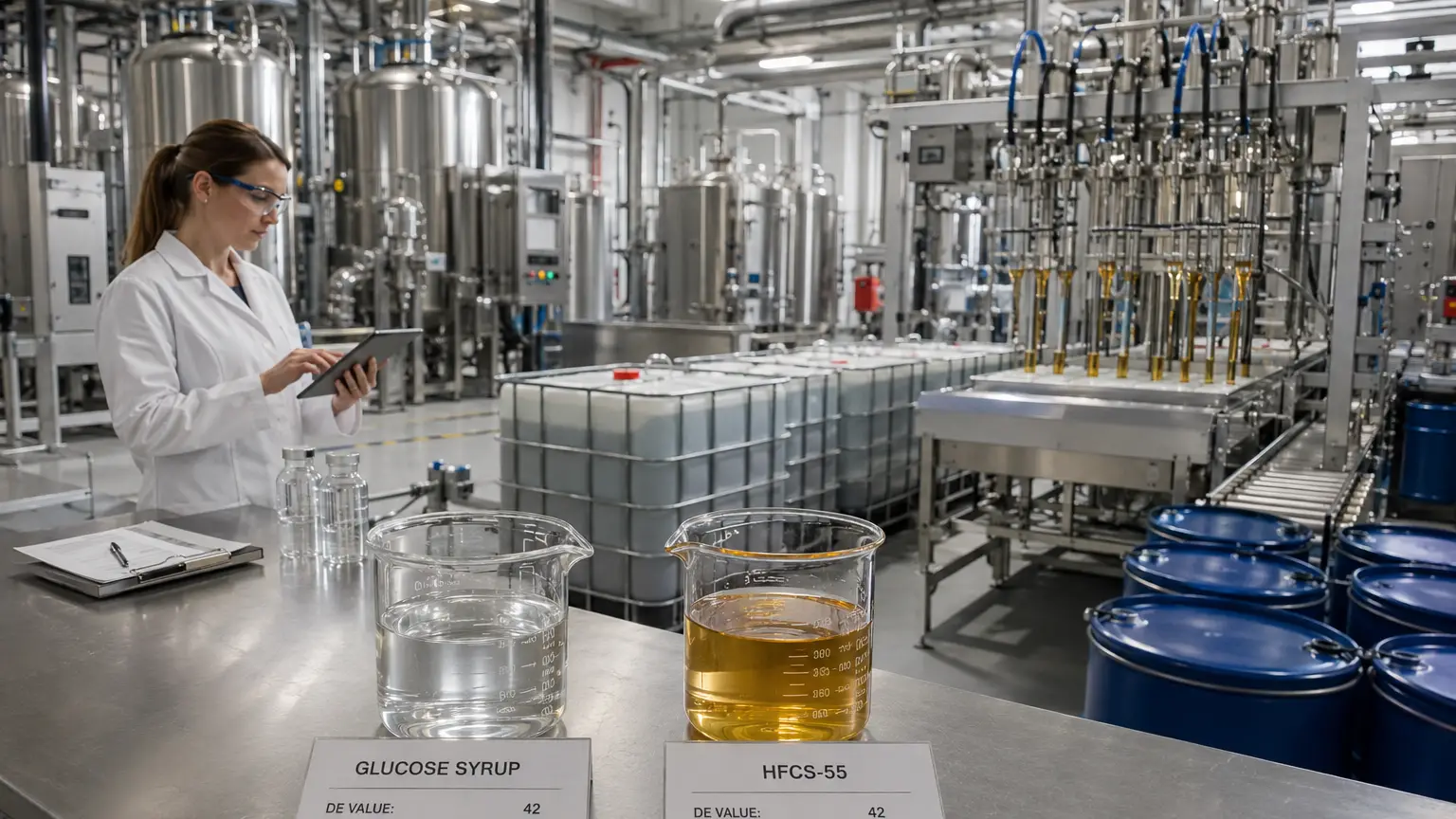
Liquid glucose and high-fructose corn syrup are both starch-derived liquid sweeteners, both produced through enzymatic hydrolysis, and both widely used across food, beverage, and pharmaceutical manufacturing. They are also frequently confused, used interchangeably in informal trade discussions despite having meaningfully different compositions, functional properties, regulatory profiles, and applications. For B2B buyers in food manufacturing, confectionery, pharmaceutical, and industrial chemical procurement, the distinction between the two is not academic: it determines product formulation performance, regulatory compliance, label requirements, and ultimately which supply chain a buyer enters. This article provides the commercial clarity that procurement teams need before making a sourcing decision.
What Is Liquid Glucose?
Liquid glucose, also referred to as glucose syrup, is a viscous, clear to pale yellow liquid produced through the partial hydrolysis of starch using acids, enzymes, or a combination of both. The starch source is most commonly corn (maize), though wheat, potato, tapioca, and rice starch are also used depending on regional feedstock availability and buyer specification requirements. The hydrolysis process breaks the long starch polymer chains into shorter glucose chains, producing a mixture of glucose (dextrose), maltose, and higher oligosaccharides (maltotriose, maltotetraose, and longer chains), without converting glucose to fructose.
The commercial characterization of liquid glucose is expressed through its Dextrose Equivalent (DE), a measure of the degree of hydrolysis. A DE of 100 represents pure glucose; commercial liquid glucose is typically produced and sold in DE ranges of 38 to 42 (standard confectionery grade), 60 to 65 (medium conversion), and 80 to 95 (high conversion, approaching pure dextrose). The DE value governs functional properties: higher-DE products are sweeter, more soluble, more fermentable, and more humectant; lower-DE products are more viscous, have stronger binding properties, and deliver better bodying effect with lower sweetness intensity.
The global liquid glucose market was valued at approximately USD 3.6 billion in 2025 for the liquid segment specifically, with the broader glucose market, across all forms, estimated at USD 53.7 billion. The liquid syrup format holds approximately 78% of total glucose volume by form, reflecting its dominance across food processing, pharmaceutical formulation, and industrial fermentation applications. The market is projected to grow at a CAGR of 6.5 to 6.6% through 2035, reaching an estimated USD 6.82 billion.
What Is High-Fructose Corn Syrup (HFCS)?
High-fructose corn syrup is a liquid sweetener produced from corn starch through a two-stage process: first, enzymatic hydrolysis converts corn starch to glucose syrup (essentially the same first step as liquid glucose production); then, a second enzymatic conversion using glucose isomerase converts a portion of the glucose to fructose, yielding a sweetener with higher fructose content than standard glucose syrup. This second isomerization step is the critical process difference that distinguishes HFCS from liquid glucose.
Two HFCS grades dominate commercial trade. HFCS-42 contains approximately 42% fructose and 58% glucose by dry weight, making it moderately sweet, suited to baked goods, cereals, canned products, and dairy applications where sucrose-equivalent sweetness is not required. HFCS-55 contains approximately 55% fructose and 45% glucose, making it effectively equivalent in sweetness to sucrose, which is why it became the dominant sweetener in North American carbonated soft drink production. HFCS-55 led with approximately 50.83% of global HFCS market share in 2025.
The global HFCS market was valued at approximately USD 9.08 to 9.88 billion in 2025 to 2026, growing at a significantly slower pace than liquid glucose, CAGR of approximately 1.6 to 3.4% through 2035, compared to liquid glucose's 6.5%, reflecting HFCS's concentrated geographic dependence on North America, where approximately 37 to 42% of global consumption is centered, and growing regulatory and consumer sentiment pressure in other markets.
Key Differences: Composition, Sweetness, and Functionality
The fundamental compositional difference between liquid glucose and HFCS is the presence, or absence, of fructose as a significant component. Standard liquid glucose (glucose syrup) contains predominantly glucose, maltose, and oligosaccharides, with minimal or no fructose. HFCS contains 42 to 55% fructose as a defining characteristic, which is the entire basis of its commercial value proposition as a sucrose substitute.
This compositional difference drives meaningful functional divergence across several parameters relevant to food and beverage manufacturers.
Sweetness intensity is the most commercially significant difference for food formulators. Fructose is approximately 1.2 to 1.7 times sweeter than glucose on an equivalent weight basis. HFCS-55 achieves near-sucrose sweetness levels; standard liquid glucose (DE 42) delivers approximately 30 to 50% of the sweetness of sucrose. This means HFCS is the appropriate choice when sucrose-equivalent sweetness is the primary functional requirement, as in carbonated beverages, while liquid glucose is preferred when sweetness should be mild and other properties such as viscosity, binding, or crystallization prevention are the primary formulation goals.
Crystallization control is where liquid glucose distinctly outperforms HFCS in confectionery applications. The oligosaccharide fraction in lower-DE glucose syrup physically interferes with sucrose crystal formation, making it the standard anti-crystallization agent in hard candies, toffees, caramels, and fondants. HFCS contains high levels of monosaccharides (glucose and fructose) but lacks the oligosaccharide matrix that gives glucose syrup its superior crystal-inhibition function. Most confectionery manufacturers globally prefer liquid glucose for crystal control applications, with HFCS serving primarily as a cost-effective sweetener additive rather than a functional crystallization control agent.
Viscosity and bodying in finished products are governed by DE value in glucose syrup, lower DE equals higher viscosity. HFCS does not offer the same viscosity modulation range, as its composition is defined by fructose content rather than molecular weight distribution. Food processors that need to adjust product body, texture, or mouthfeel through a liquid sweetener ingredient have more formulation flexibility with glucose syrup than with HFCS.
Hygroscopicity and humectancy are higher in HFCS than in standard liquid glucose, because fructose has stronger moisture-binding properties than glucose. In applications where keeping baked goods or confections moist over time is a specific requirement, as in soft cookies, moist cakes, and chewy candies, HFCS-42 can offer advantages over lower-DE glucose syrup. However, high-DE glucose syrup achieves comparable humectancy, making the choice often a function of sweetness requirement rather than moisture performance alone.
Freezing point depression is another parameter where fructose's properties are commercially relevant: HFCS is used in ice cream and frozen dessert formulations to lower the freezing point and improve scoopability. Standard liquid glucose offers more limited freezing point depression at equivalent inclusion levels.
Regulatory and Market Access Differences
The regulatory profile of HFCS and liquid glucose differs substantially across global markets, a difference that is commercially critical for buyers formulating products for international distribution.
In the United States, HFCS is classified as Generally Recognized as Safe (GRAS) and faces no usage restrictions. It is the dominant liquid sweetener in domestic food and beverage production, accounting for approximately 50% of sweetener use in the US market. North America holds 37 to 42% of the global HFCS market, with the US beverage, bakery, and processed food industries as the core consumption base.
In the European Union, HFCS is not banned, but it is structurally marginal. EU production was historically capped under the European Sugar Regime at 5% of total sugar production, which kept commercial volumes minimal. When the EU sugar quota regime ended in October 2017, production was expected to expand from approximately 0.7 to 2.3 million tonnes annually, yet HFCS still accounts for only approximately 10% of EU sweetener production. Consumer preference for sucrose and beet sugar, reinforced by strong agricultural policy support for European sugar beet farming and growing clean-label awareness, means that HFCS faces significant structural headwinds in European retail markets despite its legal status. European food manufacturers supplying retail channels actively avoid HFCS in labeling-sensitive categories.
In Asia-Pacific, HFCS consumption is growing at a CAGR of approximately 5.03% through 2031, the fastest regional growth rate globally, driven by China's large-scale beverage and food processing industry adoption. However, liquid glucose (glucose syrup) remains the dominant choice for confectionery manufacturers across Asia, particularly in markets such as India, Southeast Asia, and Japan, where confectionery tradition and pharmaceutical applications favor glucose syrup over the fructose-containing alternative.
Liquid glucose, as a glucose-dominant, fructose-free sweetener, carries no regulatory controversy in any major global market. It is approved across all significant food safety frameworks including FDA GRAS, EU food additive regulations (E400 series and permitted sweeteners), FSSAI (India), BPOM (Indonesia), and Codex Alimentarius standards. Its pharmaceutical-grade form is accepted under USP, BP, and JP (Japanese Pharmacopoeia) for excipient applications. For global manufacturers supplying multiple markets simultaneously, liquid glucose offers simpler regulatory navigation and label positioning than HFCS.
Which Industries Use Which Product
The application overlap between liquid glucose and HFCS is substantial in sweetener-dominant uses, both are used in beverages, bakery, and processed foods as sweetening agents. The divergence is most pronounced in applications where functional properties other than sweetness are the procurement driver.
Confectionery manufacturing globally uses liquid glucose as the standard co-sweetener alongside sucrose, for crystallization control, viscosity contribution, and texture management. This is a multi-billion dollar application base concentrated in Asia, Europe, and the Middle East, where sugar confectionery traditions favor glucose syrup. HFCS penetration in confectionery manufacturing outside North America is limited specifically because oligosaccharide-rich glucose syrup provides superior anti-crystallization performance.
Carbonated beverages and soft drinks in North America are the defining application for HFCS, particularly HFCS-55. Over 62% of HFCS consumption is linked to carbonated beverages globally, with the North American market as the primary base. Outside North America, most carbonated beverage manufacturers use sucrose as the primary sweetener, with liquid glucose playing a supporting functional role rather than HFCS as the primary sweetener.
Pharmaceutical formulations use liquid glucose (glucose syrup) as an excipient in oral syrups, tablet binding, and liquid drug formulations. The pharmaceutical-grade glucose syrup market is growing at an estimated CAGR of 11.3% across Asia-Pacific, driven by the expansion of oral pharmaceutical production in India and China. HFCS is also used in pharmaceutical syrup formulations but to a far lesser extent than pharmaceutical-grade glucose syrup, which has better-established pharmacopoeial monographs globally.
Bakery products use both, but for different purposes. HFCS-42 is used as a cost-effective moisture-retention and browning agent in commercial bakery in the US. Liquid glucose is used in premium bakery and artisan confectionery globally for its specific textural contributions and clean-label positioning.
Fermentation and bio-industrial applications, the fastest-growing segment for liquid glucose globally in 2026, use high-DE glucose syrup as a fermentation substrate for bioethanol, organic acid (citric, lactic, gluconic), and enzyme production. HFCS is not the preferred fermentation feedstock for these applications because the fructose component creates different fermentation dynamics than pure glucose, and most industrial fermentation organisms are optimized for glucose-dominant substrates.
Pricing Dynamics and Procurement Considerations
HFCS is generally priced lower than liquid glucose on a per-tonne basis in markets where corn wet-milling overcapacity drives competitive pricing, most significantly in the United States, where HFCS costs in soft drinks are reportedly approximately half the cost of sucrose sweetening. In 2025, US liquid glucose prices that had cleared USD 350 to 450 per tonne historically rose to over USD 638 per tonne following the 2021 to 2022 commodity inflation cycle, before softening on feedstock easing.
Outside North America, the pricing relationship shifts. In markets where HFCS must be imported from US or Chinese sources, as in Europe, Southeast Asia, and the Middle East, freight and logistics costs erode the US cost advantage significantly. In these markets, locally produced or regionally sourced liquid glucose from corn, wheat, or tapioca starch is often price-competitive with or lower than imported HFCS on a delivered-cost basis.
For buyers formulating products for markets with clean-label requirements or HFCS-avoidance consumer sentiment, a condition that applies across most of Europe, Japan, South Korea, Australia, and an increasing segment of premium retail in Southeast Asia, liquid glucose offers the dual advantage of regulatory simplicity and label positioning, in addition to superior functional performance in confectionery and pharmaceutical applications.
The most critical procurement consideration for buyers choosing between liquid glucose and HFCS is therefore not absolute price per tonne, but total formulation cost and market access value: which product achieves the required formulation performance at the lowest total cost across all target markets, including the regulatory and labeling compliance burden of each.
Tradeasia International supplies food-grade and pharmaceutical-grade liquid glucose to confectionery manufacturers, food processors, pharmaceutical producers, and industrial buyers across global markets, with sourcing networks spanning Asia, Europe, and the Americas. Buyers evaluating liquid glucose procurement, including grade specifications, DE values, certifications, and delivery logistics, can contact Tradeasia's food ingredients team to discuss their specific formulation and procurement requirements.
Outlook: How the Liquid Glucose vs. HFCS Choice Evolves Through 2030
The diverging growth trajectories of the two products, liquid glucose at 6.5% CAGR versus HFCS at 1.6 to 3.4% CAGR through 2035, reflect structural forces that will become more pronounced over the next five years rather than less. HFCS faces headwinds from clean-label consumer sentiment in Europe and premium Asian markets, regulatory stagnation in the EU, and growing competition from alternative sweeteners including stevia, erythritol, and allulose in North America. Liquid glucose benefits from expanding pharmaceutical and bio-industrial demand, growth in confectionery and processed food consumption across Asia-Pacific and Africa, and its absence from negative consumer narratives about processed sweeteners.
For buyers supplying global consumer brands, particularly those with European or premium Asian retail presence, the procurement calculus increasingly favors liquid glucose as the default liquid sweetener ingredient, with HFCS reserved for North American market formulations where cost optimization and established formulation infrastructure make it the logical choice. Buyers who maintain separate formulations for HFCS-using North American production and liquid glucose-using international production already operate this way; the structural market shift through 2030 will see more manufacturers make this bifurcation explicit in their global sourcing strategies.