Latin America contributes approximately 10–15% of global refined boric acid supply, with Chile's Quiborax (110,000 tpa installed capacity) and Argentina's Minera Santa Rita and Manufacturas Los Andes as the primary producers. Both countries mine ulexite and related borate minerals from the Andean Puna plateau and export through Pacific ports, primarily Arica, Antofagasta, and Angamos in Chile. For buyers seeking to diversify away from Turkish or U.S. origin, South American supply offers a commercially viable alternative, but with meaningful constraints on volume, grade range, and logistics reliability that require careful evaluation before contract commitment.
Why Latin America Matters in the Global Boric Acid Supply Map
Turkey and the United States dominate global boric acid supply. Eti Maden, the Turkish state mining enterprise, controls approximately 73% of world-known boron mineral reserves and exports the large majority of its refined production. Rio Tinto Borates operates from the Mojave Desert in California, producing refined boric acid and other borates at scale from kernite and borax deposits. Together, these two origins account for over 80% of the world's refined boric acid export volume.
Latin America occupies a structurally distinct third position. Chile and Argentina sit on the southern edge of the global boron reserve map, drawing from the Atacama and Puna geological systems of the Central Andes. These ulexite-bearing salt flat deposits are different in mineralogy and grade from Turkish colemanite or American kernite, which affects processing chemistry, production costs, and the specific grades each producer can economically manufacture. Latin American output is not a like-for-like substitute for Turkish supply across all applications, but for industrial-grade boric acid destined for glass, ceramics, agriculture, and general industrial use, it is a commercially relevant origin that buyers in Asia, Brazil, and elsewhere have integrated into diversified sourcing programs.
The 2026 outlook for Latin American boric acid is defined by three structural realities: Quiborax's dominant regional position and expanded capacity, Argentina's fragmented but growing producer base, and a set of upstream constraints, including water rights competition from the lithium mining boom, that buyers need to monitor closely when evaluating supply reliability over multi-year contract horizons.
Chile: Quiborax as the Andean Anchor
Chile is the larger of the two South American boric acid producers by installed capacity. Quiborax S.A., founded in 1986 with entirely Chilean investment, is the third-largest boric acid producer globally and the dominant commercial-scale operator in the region. Its processing plant is located approximately 69 kilometers from the Port of Arica in the Arica and Parinacota region, at an elevation of 1,680 meters above sea level. This location, while remote by industrial standards, places the facility within practical trucking distance of the country's northernmost deep-water export terminal.
Quiborax's installed boric acid production capacity stands at approximately 110,000 metric tons per year according to company data, representing a significant expansion from the 36,000 tpa figure reported in USGS Minerals Yearbooks covering the 2019 period. The company mines ulexite from Salar de Suirire in the Tarapacá region, one of the largest ulexite deposits in the world with reserves estimated by Quiborax at approximately 1.5 million tonnes. A second mining operation draws from Salar Ascotán in the Antofagasta region. The ulexite ore is processed via acidic leaching with sulfuric acid, followed by cooling crystallization to recover boric acid in granular or powder form.
Chilean production output has demonstrated notable volatility in the available data. According to the Chilean Copper Commission (Cochilco), boric acid mining production reached 171,422 metric tons in 2022, fell sharply to 101,875 metric tons in 2023, and averaged approximately 93,119 metric tons annually across the period from 1998 to 2023. This variability reflects the sensitivity of ulexite-based production to ore feed quality, water availability, and processing plant utilization rates. Buyers relying on Chilean origin for consistent annual volumes should account for this operational variability in their safety stock planning.
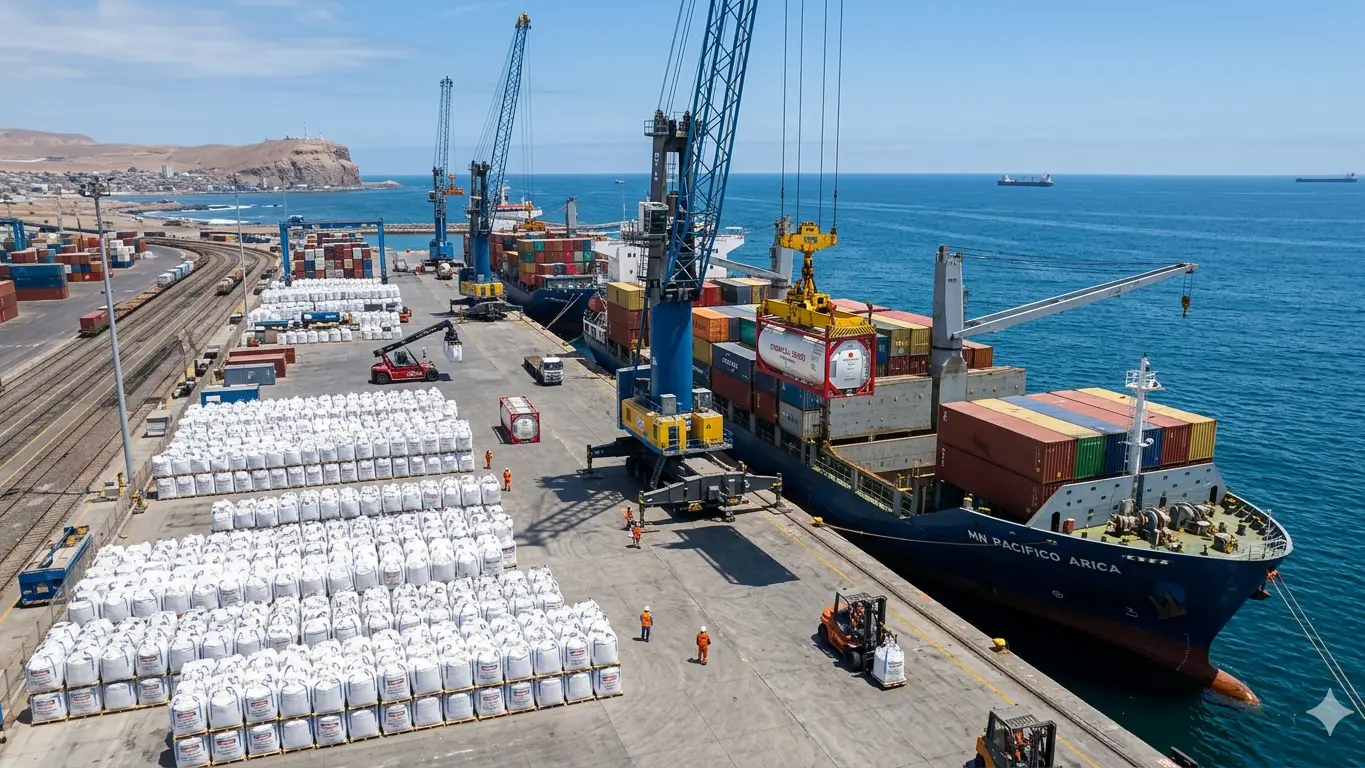
Quiborax exports to over 52 markets globally, with Pacific Ocean logistics forming the backbone of its distribution network. Primary export ports are Arica, Antofagasta, and Angamos, all of which provide containerized and bulk access to Asian, Latin American, and European buyers. Shipments are typically packed in 25 kg multi-wall paper bags with polyethylene liners or jumbo bags, containerized for ocean freight. Lead times from Chilean ports to Asian destinations range from approximately 25 to 40 days depending on routing and port of discharge.
| Producer | Location | Boric Acid Capacity (tpa) | Primary Feedstock | Key Export Port |
|---|---|---|---|---|
| Quiborax S.A. | Arica and Parinacota / Antofagasta, Chile | ~110,000 | Ulexite (Salar de Suirire, Salar Ascotán) | Arica, Antofagasta, Angamos |
| Minera Santa Rita (MSR) | Tincalayu and Sijes, Salta, Argentina | ~36,000 | Hydroboracite, Ulexite, Colemanite | Buenos Aires, via road to Chilean Pacific ports |
| Manufacturas Los Andes | Olacapato, Salta, Argentina | Est. 10,000–20,000 | Ulexite (proprietary Puna deposits) | Chilean Pacific ports via Sico Pass |
Argentina: A Fragmented but Historically Deep Industry
Argentina is the fifth-largest producer of natural borates globally, according to industry estimates. The country's borate industry is over 150 years old, dating to the first ulexite exports from the Puna region to Europe in the 1870s. Production is concentrated in the Puna plateau of Salta, Jujuy, and Catamarca provinces, where geological conditions have deposited ulexite, colemanite, and hydroboracite in economically minable concentrations.
Argentina's largest active boron operation is Minera Santa Rita S.R.L. (MSR), which operates the Tincalayu and Sijes open-pit mines in Salta province. Tincalayu, located in the Hombre Muerto salt flat, has been in operation since the 1950s and is Argentina's largest open-pit borate mine. MSR acquired the operations from Allkem Limited (formerly Orocobre) in December 2022 in a transaction that exchanged the boron assets for a strategic lithium tenement. MSR operates a processing plant at Campo Quijano near Salta city, with boric acid production capacity of approximately 36,000 tpa. The plant uses hydroboracite as its primary feedstock, which produces boric acid with lower chloride content than ulexite-based processing, an attribute that some specialty glass and ceramics buyers specify.
The Sijes range in Salta also contains significant hard-rock borate deposits, specifically colemanite and hydroboracite, which are geologically comparable to the Turkish deposits that underpin Eti Maden's production at Kütahya. This mineralogical overlap is significant: it means Salta's hard-rock borate ore can produce boric acid grades and downstream products that more closely resemble Turkish-origin material than South American ulexite-based production. For buyers who specify colemanite-derived boric acid for glass applications, Argentine hard-rock production offers a technically credible non-Turkish alternative, though at lower absolute scale.
Manufacturas Los Andes S.A. is a smaller but strategically positioned producer. Its processing plant is located at Olacapato on National Route 51 in Salta, near the Sico mountain pass crossing point into Chile. The company operates its own ulexite deposits in the Puna region, which it estimates provide sufficient feedstock for at least 20 years of operations. The plant is self-sufficient in water and power (1.5 MW of installed electricity generation capacity), which reduces two of the key operational vulnerabilities that affect other Puna producers. Manufacturas Los Andes exports boric acid and ulexite-derived products including granular Boro 10, an agricultural boron fertilizer. Estimated production capacity is in the range of 10,000 to 20,000 tpa, though the company does not publish detailed capacity figures.
The Argentine industry also includes Procesadora De Boratos Argentinos S.A. and Quimibor, both of which process borate minerals in the Salta-Jujuy corridor. Argentina's Puna currently exports borate products to more than 40 countries, with Brazil consistently the largest single destination due to its proximity and the demand from the Brazilian ceramics and glass manufacturing sectors.
Feedstocks and Upstream Geology: The Andean Advantage and Its Limits
Both Argentina and Chile produce boric acid from ulexite (NaCaB5O9·8H2O) as the primary feedstock, with Argentina's MSR additionally using hydroboracite. Ulexite is a softer, lower-grade ore than the colemanite and kernite used in Turkey and the U.S., respectively. Processing ulexite into boric acid requires acidic leaching with sulfuric acid followed by crystallization. The chemistry is well understood, and producers in both countries operate their own sulfuric acid production capacity to maintain feedstock self-sufficiency.
The geological concentration of Andean borate deposits within the Puna salt flat system creates a distinctive supply risk: multiple producers draw from geographically proximate ore bodies in an extremely high-altitude, arid environment between 3,700 and 4,200 meters above sea level. Logistics to these mines rely on unpaved roads or narrow provincial routes subject to seasonal disruption, particularly during the December-to-March austral summer wet season when flash flooding can close access corridors.
Water availability is an increasingly material operational constraint in the Puna region. The same salt flat systems that host borate deposits are now at the center of the global lithium mining boom. Argentina's lithium production reached approximately 51,400 tonnes of lithium carbonate equivalent (LCE) in the first half of 2025 alone, according to private industry data. Lithium brine extraction draws from the same aquifer systems that borate processors rely upon. Environmental regulators in Salta and Jujuy are under growing pressure from indigenous communities and international observers to restrict water extraction permits, and any tightening of water rights in the Puna region would affect borate production capacity before it affected lithium production, because lithium projects carry higher political priority and investment scale.
This is not a near-term supply disruption risk in 2026, but it is a multi-year structural constraint that buyers signing three-to-five year offtake agreements with Argentine producers should factor into their risk modeling.
Trade Flows: Where Latin American Boric Acid Goes
Latin American boric acid exports flow along three primary corridors:
Brazil: The largest single destination for Argentine and Chilean boric acid. Brazil imports boric acid principally for ceramics glazing, glass manufacturing, and agricultural micronutrient formulations. Argentina's Campo Quijano refinery ships product by road to Buenos Aires for transatlantic container export, while northern Argentine producers increasingly route cargo through Chilean Pacific ports to reduce overland transit distance and access faster oceangoing services. Brazil imported approximately USD 54.5 million worth of boric acid in 2022, making it the second-largest global importer behind China.
Asia: Quiborax exports to Asian buyers across more than 52 markets. Asian demand for Latin American boric acid is concentrated in industrial glass, ceramics, and agricultural fertilizer applications. South American origin typically competes on price against Turkish material, with logistics costs from Pacific ports to Asia adding approximately USD 60–90/MT in freight versus Turkish origin to the same destinations. This freight premium means Latin American origin is most competitive in price terms for buyers in western South America, the U.S. west coast, and Pacific Rim markets where total landed cost narrows compared to Suez-routed Turkish supply.
Europe: A smaller but consistent export channel, primarily for technical-grade and specialty boric acid from Argentine producers. European buyers absorb Argentine production for applications where material specifications match, though Turkish origin dominates European import volumes due to proximity, established logistics, and the scale of Eti Maden's product range.
| Trade Corridor | Primary Origin | Typical Volumes | Key Applications | Competitive Advantage vs. Turkey |
|---|---|---|---|---|
| Latin America to Brazil | Argentina (MSR, Mandes), Chile (Quiborax) | Moderate-High | Ceramics, glass, agriculture | Proximity, regional supply chain integration |
| Latin America to Asia | Chile (Quiborax) dominant | Moderate | Industrial glass, ceramics, fertilizer | Pacific routing, price on spot market |
| Latin America to Europe | Argentina (MSR, Mandes) | Low-Moderate | Technical grade, specialty minerals | Mineralogy-specific grades (colemanite, hydroboracite) |
| Intra-regional (Chile, Peru, Bolivia) | Chile (Quiborax) | Low | Agriculture, mining chemicals | Supply proximity, logistics simplicity |
Logistics: Pacific Ports as the Distribution Backbone
The Port of Arica is the primary export gateway for Chilean boric acid from Quiborax. Arica is Chile's northernmost port, located 18 kilometers from the Peruvian border and approximately 500 kilometers from the Argentine border via the international road corridor. The port has established container handling capacity and regular liner services to Asia, the U.S. west coast, and Europe. Quiborax's plant is 69 kilometers from Arica, meaning product can move from plant to vessel in under four hours under normal road conditions.
Antofagasta and Angamos (Mejillones) provide alternative export capacity, including bulk handling for larger shipment lots. Argentine producers in the Puna access these Chilean ports via the Sico Pass or Jama Pass corridors, both of which cross the Andes at altitudes above 4,000 meters and are subject to winter closure from June through August.
For buyers importing into South America from Argentine and Chilean producers, the key logistics risk is overland access to production sites during adverse weather. Producers typically build 4–6 weeks of finished product inventory at port warehouses in Arica, Antofagasta, or Buenos Aires to buffer against this seasonal disruption. Buyers should confirm warehouse buffer stock arrangements with suppliers before signing term contracts and should specify minimum pre-positioned inventory levels in contract terms.
Supply Risk Assessment: What Buyers Need to Monitor in 2026
| Risk Factor | Level | Trigger Scenario | Probability (2026) |
|---|---|---|---|
| Quiborax production volatility | MEDIUM | Output variance of 30–40% between years (as seen 2022 vs. 2023) creates spot availability gaps | Moderate |
| Andean road disruption | MEDIUM | Austral summer flooding (Dec–Mar) closes Puna access roads, delaying shipments 2–4 weeks | Seasonal / Annual |
| Water rights restriction in Puna | LOW-MEDIUM | Argentine regulators restrict water extraction permits, reducing borate processing capacity | Low in 2026, rising by 2028 |
| Currency and FX risk (Argentina) | MEDIUM | Argentine peso volatility affects domestic Argentine producer margins and export pricing stability | Persistent |
| Lithium competition for Puna resources | LOW-MEDIUM | Lithium project expansion competes for water, infrastructure, and skilled labor in Salta and Jujuy | Gradual, 2026–2030 |
| Port congestion (Arica, Antofagasta) | LOW | Regional shipping volume increases strain Chile's northern port capacity | Low in 2026 |
The most immediately actionable risk for buyers in 2026 is Quiborax's year-to-year production variability. The 40% output decline from 2022 to 2023 (from 171,422 to 101,875 metric tons, per Cochilco data) was not accompanied by any publicly announced force majeure event, suggesting operational factors, rather than a single discrete disruption, drove the reduction. Buyers who rely on Chilean origin as a primary supply source should maintain 6–8 weeks of safety stock and hold a backup allocation from a Turkish or U.S. origin supplier to cover potential supply gaps.
EU Critical Raw Materials Act: What It Means for Latin American Boric Acid
The European Union's Critical Raw Materials Act (CRMA), which classifies borates as a strategic raw material, has a relevant but indirect implication for Latin American producers. The CRMA's strategic designation is driven by concern over concentration risk, namely the structural dependence of European industry on Turkish-origin borates. The regulation encourages diversification of supply sources, specifically naming Argentina and Chile among the countries with borate deposits that could contribute to supply diversification, while acknowledging that current Latin American production is not at the commercial scale required to substitute for Turkish origin at European import volumes.
In practical terms, the CRMA creates policy-level interest in Latin American borate development rather than near-term volume reallocation. European chemical buyers who are under internal ESG pressure to reduce single-origin dependence on Turkish supply may use Latin American origin as a partial diversification tool, blending 15–25% of volume from Argentine or Chilean sources against a Turkish-primary contract structure. This is already occurring in a minority of European procurement programs and is expected to become more common as CRMA compliance timelines sharpen through 2025 and 2026.
Procurement Recommendations for Buyers Evaluating Latin American Origin
Buyers considering Chilean or Argentine boric acid as a primary or supplementary source in 2026 should apply the following sourcing framework:
Verify grade compatibility first. Ulexite-derived boric acid from Chilean and Argentine producers is chemically identical to Turkish-origin material at the H3BO3 molecule level, but may differ in chloride content, particle size distribution, and trace impurity profile. Hydroboracite-derived material from MSR in Argentina typically shows lower chloride than ulexite-processed product, which is an advantage in glass and electronics applications. Request a Certificate of Analysis (CoA) for at least three recent production lots before committing to a term contract.
Build a blended origin strategy. Latin American boric acid is most effective as a 20–40% blend allocation against a Turkish or U.S. primary supply agreement, not as a sole source replacement. This blending approach gives buyers price negotiating leverage against Turkish origin, adds origin diversification, and keeps Latin American suppliers commercially engaged without over-concentrating logistics risk in one corridor.
Negotiate pre-positioned port inventory. Specify in contract terms that the supplier maintains a minimum of four weeks' worth of contracted volume in finished goods inventory at Arica, Antofagasta, or another agreed port warehouse. This is standard practice for Quiborax's larger contract accounts and should be explicitly stated in procurement agreements.
Use spot purchasing cautiously. Latin American boric acid spot availability is tighter than Turkish origin because fewer trading intermediaries hold working inventory on this origin. Buyers who rely on spot purchasing from Chilean or Argentine producers for volume flexibility will face longer lead times (typically 6–10 weeks from purchase order to delivery) compared to Turkish origin, where established traders can supply from European warehouses in 2–4 weeks.
Frequently Asked Question
Q: Who are the largest boric acid producers in Latin America?
A: Quiborax S.A. of Chile is the largest Latin American producer, with an installed capacity of approximately 110,000 metric tons per year at its plant near the Port of Arica. In Argentina, Minera Santa Rita S.R.L. (operating the former Borax Argentina assets at Tincalayu and Sijes in Salta) has a boric acid capacity of approximately 36,000 tpa, while Manufacturas Los Andes S.A. at Olacapato, Salta, operates at an estimated 10,000–20,000 tpa. Together, Chilean and Argentine producers account for approximately 10–15% of global refined boric acid supply.
Q: How is Latin American boric acid shipped internationally?
A: Chilean production from Quiborax ships through Pacific ports, primarily Arica (69 km from the production plant), Antofagasta, and Angamos. Product is typically exported in 25 kg multi-wall paper bags or jumbo bags, containerized for ocean freight. Argentine producers in the Puna use overland road transport through Andean mountain passes to reach Chilean Pacific ports, or truck product south to Buenos Aires for Atlantic-side export. Transit times to Asian destinations are approximately 25–40 days from Chilean ports.
Q: What factors drive boric acid prices in Latin America?
A: Latin American boric acid prices track Turkish reference pricing with adjustments for origin differential and Pacific freight rates. Primary cost drivers at the production level are sulfuric acid costs (used as the processing reagent), diesel for mining and overland transport, energy costs for processing plants, and, increasingly, water access costs as Puna region resource competition intensifies. Argentine producers also carry FX exposure because domestic cost structures are peso-denominated while export revenues are USD-indexed.
Q: What are the main supply chain risks for Latin American boric acid?
A: The primary near-term risk is production variability at the Quiborax plant in Chile, which demonstrated a 40% year-on-year output reduction between 2022 and 2023. Overland access to Argentine Puna mines is subject to seasonal closure from summer flooding (December–March) and winter snowfall at altitude passes (June–August). Over a 3–5 year horizon, water rights restrictions driven by the lithium mining boom in the Puna region represent an emerging structural constraint for Argentine borate producers.
Q: How do Latin American boric acid buyers typically structure supply contracts?
A: Most commercial buyers source Latin American boric acid through annual or biannual term contracts, priced on a CFR or CIF basis to the buyer's port. Contract terms with Quiborax typically include quarterly volume commitments with pricing indexed to market benchmarks or negotiated fixed-price windows. For Argentine origin, buyers in Brazil frequently use DAP (Delivered at Place) contracts, with the producer managing overland logistics. Spot purchasing is possible but carries longer lead times (6–10 weeks) than Turkish or U.S. origin spot transactions.