Introduction Boric Acid
Boric acid and boron-based chemicals have become indispensable to a wide spectrum of industrial value chains, from advanced glass and ceramics to agrochemicals, metallurgy, and flame retardants. As global manufacturing shifts toward higher-performance, energy-efficient, and more sustainable materials, the strategic role of boric acid is expanding. For buyers, procurement managers, and formulators, understanding the industrial applications, quality specifications, and market dynamics of boric acid is critical to securing reliable supply and optimizing product performance.
On a global scale, boron demand has been rising steadily, driven primarily by glass and fiberglass, ceramics, agriculture, and detergents. According to industry analyses, total boron consumption (in B2O3 equivalent) has been growing in the low- to mid-single digits annually, with major producers located in the United States, Turkey, South America, and parts of Asia. In this context, industrial-grade boric acid serves as a key intermediate that translates boron resources into value-added applications across multiple sectors.
This article provides a detailed overview tailored to buyers of boric acid and other boron chemicals worldwide. It examines the industrial profile of boric acid, highlights its major applications, and outlines the global market outlook toward 2026. It also explains how international trading platforms such as chemtradeasia can help connect buyers with qualified producers, streamline logistics, and manage quality and regulatory requirements in a complex global supply environment.
Industrial Profile of Boric Acid and Boron Compounds
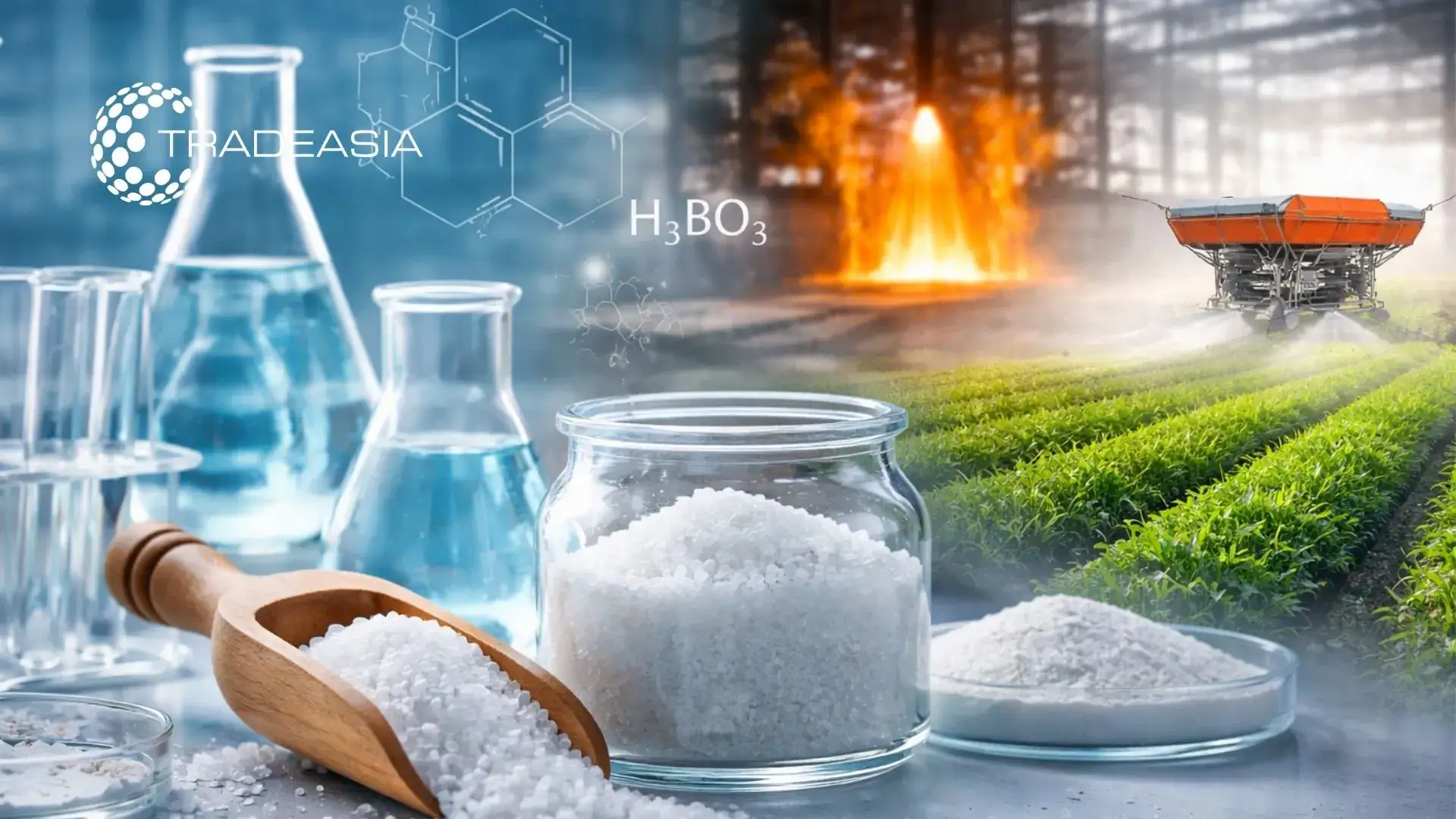
Boric acid (H3BO3), also known as orthoboric acid, is a white, crystalline, weakly acidic compound that is typically produced from borate minerals such as colemanite, ulexite, and kernite. Industrial production often involves reacting sodium borates with sulfuric acid, followed by crystallization and purification. Commercial boric acid is commonly offered in granular, powder, and crystal forms, with purity grades ranging from technical/industrial grade (often ≥99.0% H3BO3) to higher-purity grades for specialized applications.
In industrial practice, boric acid is valued less for its acidity and more for the boron content it provides. When heated, boric acid dehydrates to form metaboric acid and ultimately boron oxide (B2O3), a critical component in glass and ceramic formulations. The ability of boron oxide to modify the glass network, lower melting temperatures, and improve chemical durability underpins much of the demand for boric acid. In agriculture, boric acid acts as a boron source in micronutrient fertilizers, while in metallurgy it functions as a flux and protective agent.
Beyond boric acid, the broader family of boron compounds includes borax (sodium tetraborate), boron oxide, boron carbide, and various organoboron derivatives. Industrial buyers often consider boric acid alongside these related products when designing formulations or optimizing cost-performance ratios. For example, borax may be preferred in some detergent and glass applications, while boric acid is selected where controlled solubility, specific pH behavior, or tighter purity specifications are required. Understanding these relationships helps buyers choose the right boron source for each process.
Key Applications of Boric Acid in Global Industries
The largest single use of industrial boric acid is in the glass and fiberglass industry. When incorporated into borosilicate glass, boric acid (via B2O3) improves thermal shock resistance, chemical durability, and mechanical strength. This makes borosilicate glass ideal for laboratory ware, cookware, lighting, and high-performance glazing. In fiberglass and glass wool, boron improves fiber formation, reduces melting temperatures, and enhances insulation properties, which is critical for building materials and composites used in automotive and wind energy applications.
Ceramics and enamels represent another major demand sector. Boric acid acts as a flux in ceramic glazes, lowering firing temperatures and improving surface properties such as gloss, adhesion, and chemical resistance. In tile, sanitaryware, and technical ceramics, boron-containing frits help achieve specific thermal expansion and mechanical characteristics. Industrial buyers in the ceramics sector typically require consistent particle size distribution and low impurity levels in boric acid to avoid defects and color variations in finished products.
Beyond glass and ceramics, boric acid is widely used in agriculture, metallurgy, and flame retardant systems. As a boron micronutrient, boric acid is formulated into foliar sprays and soil-applied fertilizers to correct boron deficiency in crops such as oilseeds, fruits, and vegetables. In metallurgy, it serves as a flux and protective agent in welding, brazing, and steel heat treatment, contributing to clean metal surfaces and improved joint quality. In flame retardant applications, boric acid and borates are incorporated into cellulose insulation, wood products, and polymers to reduce flammability, suppress smoke, and inhibit fungal growth, aligning with stricter fire safety regulations worldwide.
Market Outlook to 2026: Demand, Pricing, and Trade Flows
Global demand for boron-based chemicals, including boric acid, has shown resilient growth over the past decade, supported by construction, automotive, renewable energy, and agriculture. Industry assessments suggest that boron demand is expected to grow at around 3–5% annually through 2026, with some segments, such as fiberglass for wind turbine blades and high-performance glass for solar applications, expanding even faster. This structural demand is underpinned by long-term trends toward energy efficiency, lightweight materials, and higher-yield agriculture.
On the supply side, the market is relatively concentrated, with major reserves and producers in Turkey, the United States, and parts of South America. Turkey, in particular, holds a dominant share of global boron reserves and exports significant volumes of borates and boric acid. This concentration can lead to regional supply imbalances and logistics constraints, which in turn influence pricing. Over recent years, prices for boric acid have been affected by energy costs, shipping rates, and capacity expansions or maintenance shutdowns at key production sites, resulting in periodic volatility.
Looking ahead to 2026, buyers of industrial boric acid should anticipate continued sensitivity to macroeconomic conditions, freight costs, and environmental regulations in producing countries. At the same time, emerging markets in Asia-Pacific, Latin America, and Africa are expected to increase their consumption of boron chemicals as they expand glass, ceramics, and agricultural production. In this environment, procurement strategies increasingly emphasize diversification of supply sources, long-term offtake agreements, and collaboration with global distributors such as chemtradeasia to manage cross-border trade, inventory, and compliance risks.
How chemtradeasia Supports Global Buyers of Boric Acid
As international trade in chemicals becomes more complex, many industrial users rely on specialized trading and distribution partners to secure consistent quality and timely delivery. chemtradeasia operates as a global platform connecting producers of boric acid and other boron chemicals with buyers across diverse industries. By aggregating supply from multiple qualified manufacturers, the platform helps mitigate single-source risk and offers buyers flexibility in terms of origin, packaging, and logistics solutions.
For buyers, one of the key advantages of working with chemtradeasia is access to standardized product information and documentation. Industrial-grade boric acid is typically specified by parameters such as H3BO3 content (often ≥99.0–99.5%), moisture level, insoluble matter, particle size distribution, and limits on impurities like iron, sulfate, and heavy metals. chemtradeasia assists buyers in matching these technical requirements to suitable producers, while also providing essential documents such as product specifications, certificates of analysis, and Safety Data Sheets (SDS) needed for regulatory compliance and internal quality assurance.
In addition to technical matching, chemtradeasia supports buyers with end-to-end logistics and market intelligence. This includes arranging bulk and containerized shipments, coordinating appropriate packaging (bags, big bags, or customized solutions), and advising on Incoterms, customs procedures, and local regulatory requirements in target markets. By monitoring regional price trends, freight rates, and supply-demand shifts, chemtradeasia can help procurement teams make informed purchasing decisions, plan inventories, and explore alternative supply options when market conditions change. For organizations seeking to expand or diversify their use of boric acid and boron chemicals, partnering with a specialized trading platform can significantly reduce complexity and transaction risk.
Conclusion
Boric acid occupies a central position in the global boron value chain, enabling performance enhancements in glass, ceramics, agriculture, metallurgy, and fire safety applications. Its unique ability to deliver boron in a controlled, versatile form makes it a preferred choice for many industrial formulations. As markets evolve toward higher efficiency and sustainability, the functional benefits of boric acid, ranging from improved thermal resistance in glass to enhanced crop yields in agriculture, are likely to sustain and even expand its demand.
For global buyers, the period leading up to 2026 will require careful attention to supply security, quality consistency, and regulatory compliance. Concentrated production, shifting trade flows, and environmental policies in key producing regions can all influence availability and pricing. In this context, leveraging the capabilities of international trading platforms such as chemtradeasia can help organizations navigate sourcing challenges, benchmark product specifications, and align procurement strategies with long-term business objectives.
This article is intended solely for informational and market insight purposes and does not constitute technical, safety, or professional advice; readers should independently verify all information with qualified experts, consult official documentation such as MSDS/SDS, and contact our team or other specialists for guidance on specific applications before making purchasing or operational decisions.