Boric acid supply is structurally locked into two origins — Turkey (Eti Maden) and the United States (Rio Tinto Borates) — which together control 75–80% of global refined output, per USGS data. Asia accounts for over 60% of global consumption but holds less than 5% of the world's commercially viable boron reserves, almost entirely in low-grade Chinese deposits in Liaoning province. The short answer to whether Asia is reducing import dependence: not in any meaningful way. China is investing in purification technology and sourcing diversification, but full-grade substitution of Turkish or U.S. product is not achievable within any near-term planning horizon for electronics, semiconductor, or pharmaceutical buyers.
Global Boric Acid Trade in 2026: Volume, Value, and the Structural Imbalance
Global boric acid trade was valued at approximately USD 694 million in 2022, with export volumes rising 26% from 2021 to 2022, per Observatory of Economic Complexity data. By 2025, the total market — covering all grades and applications — reached approximately USD 1.15 billion, with the market forecast to reach USD 1.21 billion in 2026 and expand at a 5.4–5.5% CAGR through 2035, according to Research Nester and Future Market Insights.
The structural feature that defines every trade flow in this market is reserve geography. Turkey holds approximately 73% of the world's known boron mineral reserves, concentrated in Kütahya and Balikesir provinces, where ore grades average 26–31% B2O3. China holds approximately 3% of global reserves, in low-grade deposits in Liaoning and Qinghai averaging 6–9% B2O3, per USGS data. The United States holds the third commercially significant reserve base, centered at Boron, California, where Rio Tinto mines tincal and kernite averaging 25–32% B2O3.
That reserve distribution creates the demand-supply asymmetry that defines Asian procurement: a region consuming over 60% of global output — with Asia Pacific alone holding a 43.2% market share in 2024, per IMARC Group — sourcing almost entirely from two suppliers on the other side of the world.
| Trade Flow Variable | 2022 Value | Trend |
|---|---|---|
| Global boric acid trade value | USD 694 million | Rising (+26% from 2021) |
| Turkey boric acid exports | USD 194 million | Stable-rising |
| U.S. boric acid exports | USD 202 million | Declining (SVM closure 2026) |
| China boric acid imports | USD 262 million | Rising |
| Brazil boric acid imports | USD 54.5 million | Stable |
The Export Side: Turkey and the U.S. Dominate, but One Just Got Smaller
Turkey: The Structural Dominant
Eti Maden, the Turkish state-owned enterprise that holds a legal monopoly on boron mining under Turkish Law No. 2840, benefits from subsidized domestic electricity rates. That subsidy is not a marginal cost advantage — it is the mechanism by which Turkish product sets the global price benchmark. Competing producers in California carry full commercial electricity rates, environmental compliance costs, and U.S. labor rates that are structurally higher.
Eti Maden is a state-owned Turkish mining company that possesses 74% of the world's known boron reserves and supplies nearly half the world's boron product demand. Eti Maden's Asia Pacific marketing subsidiary — Etimaden Asia Pacific Limited — handles commercial sales across China, Taiwan, Vietnam, the Philippines, Indonesia, Thailand, Malaysia, Singapore, and adjacent markets. For most Asian buyers, this entity is the first and last origination point for quality-assured refined boric acid.
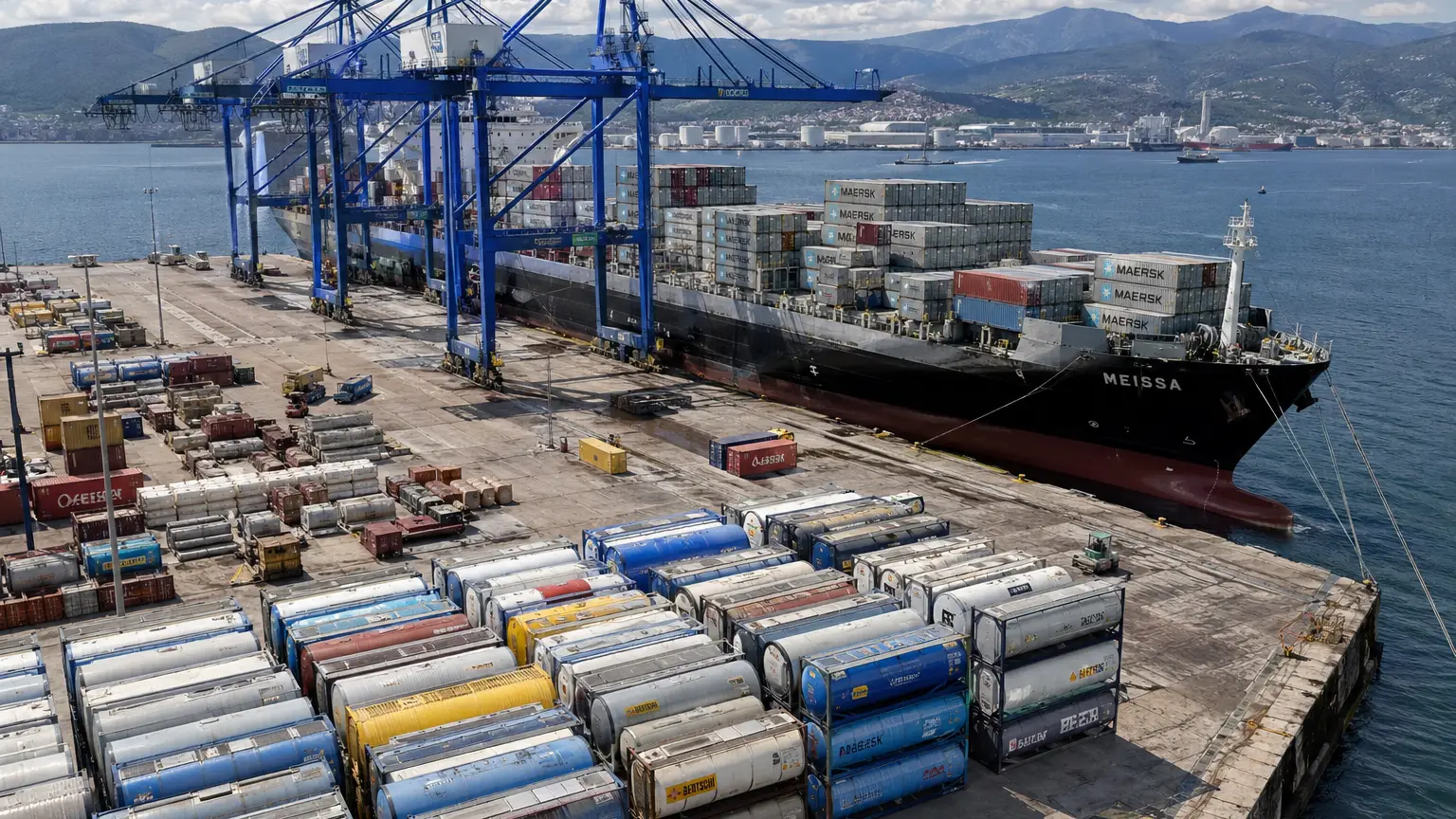
Production is not at a single facility. Eti Maden's major boric acid and borate processing operations run from Emet and Kirka in Kütahya province, with the Bandirma facility on the Sea of Marmara providing direct maritime access. Product moves approximately 200–250 km by rail or road from the mine gate to the port of Gemlik, then by container or bulk vessel through the Bosphorus and into global trade lanes.
The United States: Shrinking, Not Growing
Rio Tinto Borates remains the second pillar of global supply, mining at Boron, California, and exporting through the Port of Los Angeles via railcar. In 2024, the U.S. exported boric acid to China, the Netherlands, South Korea, Taiwan, and Brazil as leading destinations, per USGS Mineral Commodity Summaries (2025).
The U.S. supply base contracted in early 2026. The inorganic chemical producer Searles Valley Minerals (SVM) idled its soda ash and boric acid facilities in Trona and Argus, California, saying it cannot compete in international markets with overseas producers, particularly ones in China. SVM, which is one of only two U.S. makers of boron products, notes that the U.S. Geological Survey added boron to its list of critical minerals. The affected facilities processed brine from Searles Lake in the Mojave Desert. SVM's retained operations at Westend, California, produce sodium borate and sodium sulfate only, not boric acid.
The SVM closure removes a secondary U.S. volume source and increases effective global concentration onto two producers: Eti Maden and Rio Tinto Borates. Buyers in India and Southeast Asia who had previously used U.S.-origin product as a secondary origin face a tighter procurement environment in 2026 as a direct result.
A new entrant exists but is not yet meaningful at scale. By October 2025, 5E Advanced Materials had shipped 20 tons of commercial boric acid from its Fort Cady facility in Newberry Springs, California. While current output is small relative to global demand, the investment signals that the U.S. is treating domestic boric acid supply as a national security question, not merely a commercial one. The Nevada-based Rhyolite Ridge project (ioneer Ltd), backed by a USD 996 million DOE loan secured in January 2025, targets 175,000 tonnes per year of boric acid once operational, though the Bureau of Land Management only completed its final environmental impact statement in September 2024. Commercial volumes from Rhyolite Ridge are a minimum of 5–7 years from material market impact.
Minor Exporters: Chile, Peru, Russia, Argentina
Chile and Peru export primarily ulexite-derived product, with Quiborax in Bolivia representing a secondary South American source with approximately 36,000 t/year boric acid production capacity. These origins absorb a portion of South American demand (Brazil in particular) and provide limited supply into Asian spot markets. They do not displace Turkish product for high-specification applications because the ore grades and refining infrastructure for electronics or pharmaceutical-grade material are not equivalent.
The Import Side: Asia's Structural Dependency by Country
China: Largest Importer, Constrained Self-Sufficiency Aspirant
China absorbed approximately USD 262 million in boric acid imports in 2022, making it the world's largest single importing nation — and demand has grown since. China's domestic consumption reached approximately 308,000 tonnes in 2021, per IndexBox, placing it as the second-largest consuming market globally.
The self-sufficiency picture is structurally unfavorable. China holds only 3% of global borate reserves, with Liaoning and Qinghai as the main areas with minable borate resources. Although there are more than 100 identified borate deposits in China, their mining potential and low-grade nature mean that China must import significant amounts of borates from Russia, Turkey, Chile, and Peru.
The ore grade problem is not a procurement challenge — it is a geological constraint. China's ludwigite deposits in Liaoning average 6–9% B2O3. Turkish colemanite and tincal average 26–31% B2O3. Closing that quality gap through beneficiation requires energy-intensive processing steps that erode any cost advantage from using domestic ore.
China's domestic boron production from Liaoning province is low-purity and insufficient for electronics applications, but Chinese producers have been investing in purification technology. In parallel, China has been increasing imports from South American sources as a supply diversification measure. Chinese demand for high-purity Turkish and American boric acid is expected to persist for electronics and pharmaceutical applications regardless of domestic expansion.
China's semiconductor sector recorded approximately 15% growth in 2024, according to market intelligence cited by Chemtradeasia. That growth profile drives consistent demand for high-purity boric acid that Liaoning deposits cannot satisfy. For industrial-grade applications in ceramics and construction, domestic production plays a larger role — but not for the high-growth, high-value segments.
India: The Fastest-Growing Import Market
India has emerged as one of the most consequential demand growth stories in boric acid, and its procurement environment in 2026 is the tightest it has been in this decade.
India presents a story of explosive growth driven by policy. The PLI schemes are catalyzing local manufacturing of electronics, specialty chemicals, and pharmaceuticals — all boron-intensive industries. While India has some borax reserves, it remains a net importer of boric acid. The Q1 2026 trend is characterized by aggressive stockpiling by new manufacturing plants coming online, leading to volatile demand spikes.
India's primary source is Turkey. In 2023, India imported approximately 2.39 million kg of boron compounds from Turkey valued at USD 3.13 million, making Turkey the largest single origin supplier to the Indian market. Indian buyers access Turkish product through Eti Maden's commercial division, through trading companies, or via regional distributors maintaining warehousing at port hubs in Gujarat (Mundra, Hazira) and Maharashtra (Nhava Sheva / JNPT).
The Indian import corridor — Turkey to India via Suez — faces two simultaneous pressures in 2026: Red Sea security disruptions rerouting vessels around the Cape of Good Hope, adding 10–21 transit days to Turkey-India voyages, and the SVM closure removing a secondary North American volume that Indian buyers had used for specification arbitrage. The result is a tighter-than-seasonal procurement environment with extended lead times and elevated working capital requirements.
Japan and South Korea: Small Volume, Premium Grade
Japan and South Korea are high-value but lower-volume importers, absorbing electronics-grade and pharmaceutical-grade boric acid for semiconductor manufacturing, LCD glass substrates, and specialty chemicals. In Q2 2025, boric acid prices in Japan reached approximately 1,076 USD/MT, reflecting electronics-grade premium demand. Northeast Asia trades at approximately USD 2.46/KG due to full import dependency.
These markets source from both Turkish and U.S. origins depending on grade specification. Rio Tinto's OptiBor product line is specifically positioned for high-purity applications in Northeast Asian electronics supply chains. With SVM's closure removing one U.S. supply node, competition for Rio Tinto's high-purity export volumes will intensify between Japanese and Korean buyers and equivalent-specification buyers in Taiwan and China.
Southeast Asia: High Growth, Full Import Dependency
Indonesia, Vietnam, Thailand, Malaysia, and the Philippines constitute a high-growth import region with no domestic boron production. Boric acid enters Southeast Asian markets primarily via container from Turkey (through Singapore or direct to Jakarta, Ho Chi Minh City, Bangkok) or from Chinese trading intermediaries who re-export refined product. The region's demand is growing at a CAGR exceeding 5–6% annually, per Chemtradeasia, driven by electronics assembly, fiberglass for construction, ceramics, and agricultural micronutrients.
| Country / Region | Import Dependency | Primary Origin | Key End Uses | Growth Trajectory |
|---|---|---|---|---|
| China | Partial (industrial grade domestic) | Turkey, U.S., Russia | Electronics, glass, ceramics | Rising — purification investment ongoing |
| India | High | Turkey | PLI-driven electronics, pharma | High — Q1 2026 aggressive stockpiling |
| Japan / South Korea | Near-total | Turkey, U.S. (OptiBor) | Semiconductors, LCD glass | Stable at premium grade |
| Southeast Asia | Total | Turkey (via Singapore), China re-export | Construction glass, fiberglass, agri | High — 5–6% CAGR |
| Europe | Near-total (98%) | Turkey | Glass, ceramics, wood preservation | Stable; constrained by construction downturn |
How Boric Acid Moves: Primary Trade Routes and Logistics Constraints
Boric acid ships as a granular or crystalline white solid — packaged in 25 kg bags or 500–1,000 kg jumbo bags (FIBC/big bags) — and does not require refrigeration or chemical tanker handling. That simplifies logistics relative to liquid chemicals: standard 20-foot or 40-foot dry containers handle most shipments.
Turkey to Asia (primary corridor): Product leaves Eti Maden's Kütahya operations by rail or road to Gemlik port on the Sea of Marmara, transits the Bosphorus, moves through the Mediterranean, and enters the Suez Canal before proceeding to Indian ports (Nhava Sheva, Mundra, Chennai) or onward to Southeast and Northeast Asia. Transit times on this corridor under normal conditions run 20–30 days to Indian ports and 30–40 days to China or Southeast Asia.
Red Sea disruption impact: The ongoing Houthi-related security situation in the Red Sea has forced major carriers to reroute around the Cape of Good Hope since late 2023, adding 10–21 days per voyage. That bullishness coupled with the conflicts in the Red Sea, which sent freight rates soaring, made boric acid imports more expensive, especially in the second quarter of 2024. With some shipments delayed by 20–40 days, a few consumers in Asia reported that supply was insufficient at times. By 2026, rerouting has become normalized, but the additional transit time means Asian buyers who modeled 25–30 day lead times from Turkey now need to plan for 40–50 days, with corresponding safety stock implications.
U.S. to Asia (secondary corridor): Rio Tinto ships boric acid from its Wilmington, California, export hub and the Port of Los Angeles to China, South Korea, Taiwan, and Japan. This lane carries electronics-grade and pharmaceutical-grade product. Transit to Northeast Asia runs 12–18 days. The SVM closure does not affect this route, but it does increase competitive pressure on Rio Tinto's allocatable export volumes.
South America intra-regional: Quiborax (Bolivia) and Argentine producers (Borax Argentina SA) supply Brazilian and South American demand via bulk or container from Pacific and Atlantic port options. These volumes do not materially reach Asian markets.
Supply Risk Assessment: Boric Acid in 2026
| Risk Dimension | Rating | Primary Driver |
|---|---|---|
| Concentration Risk | CRITICAL | Eti Maden + Rio Tinto = 75–80% of global refined supply |
| Geopolitical Risk | HIGH | Turkish state monopoly under Law No. 2840; policy pricing exposure |
| Logistics Risk | HIGH | Red Sea rerouting adding 10–21 days to Turkey-Asia lanes |
| Structural Supply Risk | HIGH | SVM closure in early 2026 removes secondary U.S. volume |
| Demand Growth Risk | MEDIUM | Asia demand growing faster than new capacity can enter market |
Concentration Risk: CRITICAL
No other commodity chemical of comparable industrial significance has a more concentrated supply structure. Eti Maden alone accounts for approximately 60% of global refined boric acid supply, per Fastmarkets. Together with Rio Tinto Borates, the two producers control 75–80% of global output. There is no third-origin alternative capable of supplying pharmaceutical-grade or electronics-grade product at scale. When Eti Maden adjusts pricing or allocation — as buyers reported in mid-2024, describing "tougher negotiations with Turkey" — the market has no effective countervailing supply base.
The upside risk scenario for Asian buyers is straightforward: if Eti Maden faces a production disruption — whether from an extended maintenance shutdown at Kirka, a Turkish energy policy change removing subsidized electricity rates, or a geopolitical event affecting Turkish export logistics — global average prices could move from the 2026 forecast range of USD 1.25–1.45/KG toward USD 1.60–1.80/KG, with Northeast Asian electronics-grade material potentially breaching USD 3.00/KG, per Chemtradeasia's pricing analysis. There is no alternative supply base capable of substituting within a 60–90 day window.
Geopolitical Risk: HIGH
Turkey's boron operations operate under a statutory framework that concentrates mining and marketing rights in a single state entity. The Turkish government has historically used Eti Maden's pricing as both a commercial and a geopolitical instrument. The USD/TRY exchange rate is a compounding variable: when the lira depreciates against the dollar, Eti Maden's lira-denominated production costs become cheaper in dollar terms, compressing FOB Turkey offers even as global demand firms. USD/TRY trading in the 48–55 range through 2026 means this dynamic has been supportive of relatively competitive Turkish pricing in the near term.
The EU's Critical Raw Materials Act, implemented in 2024, classifies borates among 30 strategic critical raw materials and sets a benchmark that no single country should supply more than 65% of any strategic input. Turkey's 98% share of EU borate supply far exceeds this ceiling. EU-funded projects to assess Serbian, Portuguese, and other European borate occurrences are underway, but commercial production from any new European source is at minimum 8–12 years from relevance.
Logistics Risk: HIGH
Red Sea disruption is not resolved entering 2026. The practical consequence for Asian boric acid buyers is that safety stock calculations built on pre-2024 transit times are outdated. A buyer in India relying on Nhava Sheva delivery who previously modeled 4–5 weeks from order placement now needs 6–8 weeks minimum. Distributors without forward inventory face spot availability constraints when demand spikes coincide with shipping delays, as occurred for some Asian consumers in 2024.
Pricing Dynamics: Why Asia Pays a Structural Premium
Global boric acid prices are forecast in the USD 1.25–1.45/KG range in 2026, per Expert Market Research. That global benchmark conceals a pronounced regional divergence.
Northeast Asia trades at approximately USD 2.46/KG, reflecting full import dependency combined with electronics-grade specification premiums and full ocean freight from Turkey or California. China's domestic boric acid price reached approximately USD 0.937/KG (CNY equivalent) in December 2025 for domestically-produced industrial-grade material, per IMARC, but this product is not substitutable for high-purity applications. The U.S. domestic market recorded approximately USD 0.81/KG in Q3 2025, reflecting softer fiberglass and construction demand.
The production cost floor for boric acid from a well-configured colemanite-to-boric-acid plant is approximately USD 0.70/KG, per techno-economic analysis published in Mineral Processing and Extractive Metallurgy Review. At a global benchmark of USD 1.25–1.45/KG, the margin layer above cash cost is meaningful — and concentrated almost entirely in Turkish hands.
Boric acid production is energy-intensive. Converting colemanite or tincal ore into refined boric acid requires a six-stage process: dissolution, settling, crystallization, filtering, drying, and conveying, with calcination stages demanding sustained temperatures above 900°C for certain ore types, per Mordor Intelligence's 2026 boron market analysis. Energy accounts for a substantial share of operating costs, which is why Eti Maden's subsidized Turkish electricity rates translate directly into structural price competitiveness that non-Turkish producers cannot replicate without equivalent subsidy structures.
Sulfuric acid is the primary chemical reagent in colemanite processing. When sulfuric acid prices hold stable — as they did through Q1–Q2 2026 — boric acid pricing reflects demand and freight dynamics more than feedstock pressure. When sulfuric acid markets tighten, boric acid production costs escalate quickly given the approximately 30% raw material contribution to total operating cost.
The Three Structural Shifts Reshaping Boric Acid Trade Flows in 2026
Three developments are reshaping how boric acid moves globally entering 2026, though none of them materially reduces Asia's import dependency in the near term.
Shift 1: U.S. domestic production as a strategic priority. The SVM closure and simultaneous U.S. government investment in 5E Advanced Materials' California facility and ioneer's Nevada project signal a shift in U.S. boron policy. The U.S. added boron to its critical minerals list; the DOE committed USD 996 million to ioneer's Rhyolite Ridge project. These investments will gradually reduce U.S. dependence on Turkish origin over a 7–10 year horizon and may free up Rio Tinto export allocations for Asian markets — but they offer no relief to Asian buyers in 2026.
Shift 2: EU strategic materials diversification. The EU Critical Raw Materials Act's classification of borates accelerates government-funded exploration of European borate occurrences in Serbia, Portugal, and adjacent countries. At 98% Turkish import dependency, European buyers are among the most exposed globally. The practical implication for Asian markets is indirect: if European buyers develop alternative supply, some Eti Maden export volume previously directed to Europe may redirect toward Asia, slightly improving availability — but this is a 2030+ scenario.
Shift 3: China's incremental self-sufficiency progress — limited by geology. Chinese producers, including Yunnan Boron Co., are investing in vertically integrated processing and purification technology. Domestic consumption of boron products reached 900,000 tonnes in 2018 at 6.3% annual growth, while domestic production capacity in terms of boric oxide runs approximately 160,000 tonnes per year — a gap that cannot be closed by domestic production alone at current ore grades. For industrial applications (agricultural micronutrients, basic ceramics), Chinese domestic product plays a growing role. For semiconductor fabrication, LCD glass, and pharmaceutical applications, Turkish and U.S. origin material remains the only compliant option.
Conclusion: Asia Is Not Reducing Import Dependence — It Is Learning to Manage It
Asia's boric acid supply chain in 2026 is defined by growing demand against an essentially static supply structure. The region consumes over 60% of global output and controls less than 5% of commercially viable reserves. China's domestic boron industry can partially serve low-specification industrial demand, but cannot reach the purity levels required for the applications driving the fastest demand growth: semiconductors, LCD glass, solar panel borosilicate, and pharmaceutical formulations.
The SVM closure in early 2026 has made a concentrated market more concentrated. New U.S. and Australian investment in borate production will matter — but not before 2030 at the earliest. Turkey, through Eti Maden's statutory monopoly and geological advantage, will remain the price-setting origin for global boric acid for the foreseeable future.
For Asian buyers, the actionable conclusion is clear: import dependency is structural, not temporary. The risk management question is not about reducing exposure to Turkish supply — it is about ensuring that exposure is managed through term contracts, adequate inventory buffers, and grade-appropriate sourcing strategies that match procurement approach to specification reality. Companies that understand this distinction and act on it before the next supply disruption will carry lower cost and lower availability risk than those that treat boric acid as a fully substitutable spot commodity.
Tradeasia supports procurement teams across Asia in evaluating supply origins, negotiating term contract structures, and building resilient sourcing programs for boric acid and boron compounds across industrial, pharmaceutical, and electronics-grade specifications. Enquire about current availability and pricing for your delivery location and volume requirement.
Frequently Asked Questions
Q: Who are the largest producers of boric acid globally? A: Turkey's state-owned Eti Maden is the world's largest boric acid producer, holding approximately 60% of global refined supply and controlling 73–74% of known boron mineral reserves under a statutory monopoly. Rio Tinto Borates (U.S.) is the second major producer, operating at Boron, California. Together, the two producers control 75–80% of global refined boric acid supply, per USGS data.
Q: How is boric acid transported internationally? A: Boric acid ships as a granular or crystalline white solid in 25 kg bags or 500–1,000 kg jumbo bags (FIBC), transported in standard dry containers. No chemical tanker or refrigeration is required. The primary Asia-bound trade lane runs from Turkey's Gemlik port through the Bosphorus, Mediterranean, and Suez Canal to Indian ports (Nhava Sheva, Mundra) and onward to Southeast and Northeast Asia. Current Red Sea rerouting adds 10–21 days to Turkey-Asia transit times.
Q: What factors drive boric acid prices in Asia? A: Three factors dominate: Eti Maden's FOB Turkey pricing (set by energy costs and Turkish lira/USD dynamics), ocean freight costs on the Turkey-Asia corridor, and grade premium for electronics-grade versus industrial-grade product. Northeast Asia pays approximately USD 2.46/KG for electronics-grade material, compared to a global benchmark of USD 1.25–1.45/KG forecast for 2026, per Expert Market Research.
Q: What are the main supply chain risks for boric acid buyers in Asia? A: Supply concentration is the primary risk — Eti Maden and Rio Tinto control 75–80% of global supply with no credible near-term alternative. A production disruption at Eti Maden's Kirka or Emet facilities could push global prices to USD 1.60–1.80/KG and Northeast Asian electronics-grade prices above USD 3.00/KG within 60–90 days. Secondary risks include Red Sea logistics disruption extending transit times and the February 2026 SVM closure reducing U.S. backup supply.
Q: Can Asian buyers reduce dependence on Turkish boric acid? A: For industrial-grade applications, partial origin diversification is possible using Chinese domestic production (for ceramic and agricultural uses), South American origins (Chile, Peru, Bolivia), or U.S. product from Rio Tinto. For electronics-grade, pharmaceutical-grade, and high-purity semiconductor applications, Turkish and U.S. origin material is not substitutable with currently available alternatives. China's domestic boron deposits in Liaoning average 6–9% B2O3 versus 26–31% for Turkish ore — a quality differential that cannot be bridged by processing investment alone at meaningful scale.