Turkey, through state-owned Eti Maden, controls approximately 73% of the world's known boron reserves and functions as the dominant global supplier of refined boric acid, accounting for roughly 98% of EU imports and a significant share of Asian demand. Boric acid is shipped primarily as a granular solid in bulk containers or bags from Turkish Mediterranean ports, with Bandirma and Emet serving as primary production points feeding export logistics through Mersin and Gemlik. Buyers in Europe and Asia face concentrated single-country exposure that has no short-term alternative at commercial scale — the practical question is not whether to source from Turkey, but how to structure contracts to manage pricing and availability risk.
Global Boric Acid Trade in 2026: One Country, One Producer, Near-Total Market Control
The boric acid global trade map has an architecture that is unusual even by chemical market standards: a single state-owned company in a single country controls the dominant share of both reserves and refined product supply. Eti Maden, the Turkish government mining enterprise established in 1935, holds a legal monopoly on boron mining and marketing in Turkey under Law No. 2840. Turkey holds approximately 73% of the world's known boron mineral reserves, and Eti Maden exports over 95% of its production to international markets.
Global boric acid trade was valued at approximately USD 694 million in 2022, with exports increasing 26% from 2021 to 2022, per Observatory of Economic Complexity data. By 2025, the global boric acid market was valued at approximately USD 1.15 billion across all grades and applications. The U.S. and Turkey together account for the majority of global refined boric acid exports. In 2022, Turkey exported approximately USD 194 million in boric acid, with the U.S. at approximately USD 202 million. On the import side, China absorbed approximately USD 262 million and Brazil approximately USD 54.5 million in the same year.
What makes Turkish supply structurally distinctive is not just volume but reserve longevity. With colemanite deposits at Hisarcik-Espey in Kutahya alone containing roughly 40% of the world's colemanite reserves, Turkey's feedstock position is not at risk of near-term depletion. The question for 2026 is not supply adequacy in aggregate, but pricing, logistics execution, and the geopolitical exposure of being almost wholly dependent on a state-controlled supplier.
Turkey's Production Infrastructure: Where Boric Acid Is Made Before It Ships
Eti Maden operates four primary production directorates, each feeding downstream refined product output that enters the export market:
| Facility | Location | Primary Output | Notes |
|---|---|---|---|
| Kirka Boron Operations | Eskisehir | Borax pentahydrate, borax decahydrate, anhydrous borax | 3 million MT tincal ore per year |
| Emet Boron Operations | Kutahya | Boric acid (primary site) | 290,000 MT/year boric acid capacity; world's largest colemanite deposit |
| Bandirma Operations | Balikesir | Refined boric acid, borax, boron oxide | Key port-adjacent export facility |
| Bigadic Operations | Balikesir | Colemanite, ulexite | Ore feed for downstream refining |
The Emet facility is the backbone of global boric acid supply. Three sequential investments in 2005, 2011, and 2015 expanded Emet's boric acid production capacity to 290,000 MT per year. The process at Emet runs from open-pit colemanite extraction through physical concentration, reaction with sulfuric acid, filtration, crystallization, and drying to produce refined boric acid in standard and specialty grades.
Bandirma's position on the Sea of Marmara gives it direct maritime access to European and Mediterranean buyers, making it the export logistics hub most directly connected to European glass, ceramics, and fiberglass demand. Emet's inland location in Kutahya means product must move by rail or road to reach Gemlik or other Marmara ports before loading.
Top Boric Acid Exporting Countries: Turkey, the U.S., and Distant Alternatives
Turkey and the United States together supply the overwhelming majority of global refined boric acid exports. Secondary exporters have limited scale and largely fill niche demand rather than replacing primary origin exposure.
| Country | Estimated Export Value (2022) | Key Destinations | Dominant Producer | Reserve Base |
|---|---|---|---|---|
| Turkey | ~USD 194M | China, EU, India, Japan | Eti Maden (state monopoly) | 73% of global boron reserves |
| United States | ~USD 202M | Japan, South Korea, EU | U.S. Borax (Rio Tinto subsidiary), Searles Valley Minerals | Mojave Desert deposits (Boron, CA) |
| Chile | Secondary | Latam, regional | Quiborax, Minera Santa Rita | Atacama brine deposits |
| Russia | Secondary | Central Asia, China | Dalnegorsk producers | Far East deposits |
| Peru | Minor | Regional | Smaller producers | Andean borate deposits |
The U.S. export position is structurally different from Turkey's. Rio Tinto's U.S. Borax operates the Boron mine in California's Mojave Desert, producing refined boric acid, borax, and boron products for export, predominantly to Asia-Pacific buyers. However, U.S. production is also heavily consumed domestically, and U.S. export volumes are not positioned to absorb a meaningful disruption in Turkish supply to Europe.
Chile and Peru supply primarily South American and some Asian buyers at lower volumes. Neither has the infrastructure, capacity, or reserve scale to substitute for Turkish or American supply at European or major Asian import terminals on a short lead time.
Who Buys Turkish Boric Acid: Destination Markets in 2026
China: The Largest Single Importer
China absorbs the highest share of global boric acid imports, estimated at 30-35% of each major boron product category. Chinese demand is driven by glass fiber manufacturing (including the fiberglass insulation used in construction and the electronic-grade glass used in circuit boards and LCD screens), ceramics, and agricultural micronutrient applications. China's semiconductor industry, which recorded approximately 15% growth in 2024, depends on high-purity boric acid for glass substrates and insulation materials.
China imports boric acid from Turkey and, for certain specialty grades, from the U.S. and Japan. Domestically, China has its own boron deposits primarily in Liaoning province, but domestic production quality and purity are insufficient for the most demanding electronics and pharmaceutical applications, maintaining Chinese dependence on Turkish and U.S. refined product.
European Union: Near-Total Turkish Dependence
The EU imports approximately 98% of its boron compounds from Turkey. This figure, cited in a 2024 European Parliament question on import dependency, reflects both the geographic logic of Turkish proximity and the absence of any commercial-scale European borate resource. The EU's Critical Raw Materials Act, adopted in 2024, classifies borates among the 30 strategic critical raw materials, formally acknowledging supply concentration risk.
European end-use demand breaks down across glass manufacturing (flat glass, fiberglass, borosilicate), ceramics, flame-retardant textiles, wood preservatives, and agricultural micronutrients. Germany is the largest single national consumer, primarily through the glass and construction materials sectors. German construction's prolonged contraction through 2024-2025 dampened near-term demand, but structural demand from the energy transition, including fiberglass for wind turbine blades, provides a longer-horizon growth driver.
European buyers source boric acid primarily through Eti Maden's AB Etiproducts OY subsidiary, which handles distribution into Scandinavia, Eastern Europe, and adjacent markets, or through trading companies and regional distributors who take product on term contracts from Eti Maden's commercial division.
India: Turkey's Fastest-Growing Export Destination
India is an increasingly significant buyer of Turkish boric acid. In 2023, India imported approximately 2.39 million kg of boron compounds from Turkey valued at USD 3.13 million, making Turkey the largest single origin supplier to the Indian market, ahead of the U.S. (0.77 million kg, USD 2.05 million) and China (0.56 million kg, USD 1.55 million), per World Bank WITS trade data.
Indian demand is driven by agricultural micronutrient applications (boric acid as a boron fertilizer additive), pharmaceuticals, glass, and ceramics. The pre-Kharif season creates a pronounced demand pulse in April through June, during which Indian buyers typically compete for available supply and logistics capacity from Turkish origin. Buyers who have not secured term contracts ahead of this window face spot market exposure.
Japan and South Korea: High-Purity Electronics Grades
Japan and South Korea are smaller-volume but higher-value importers, absorbing pharmaceutical-grade and electronics-grade boric acid for semiconductor manufacturing, LCD glass, and specialty chemicals. In Q2 2025, boric acid prices in Japan reached approximately 1,076 USD/MT, reflecting the premium that high-purity grades command versus industrial-grade material. These markets source from both Turkish and U.S. origins depending on grade and specification, with U.S. Borax's OptiBor product line positioned in high-purity applications.
How Turkish Boric Acid Moves: Logistics Routes and Lead Times
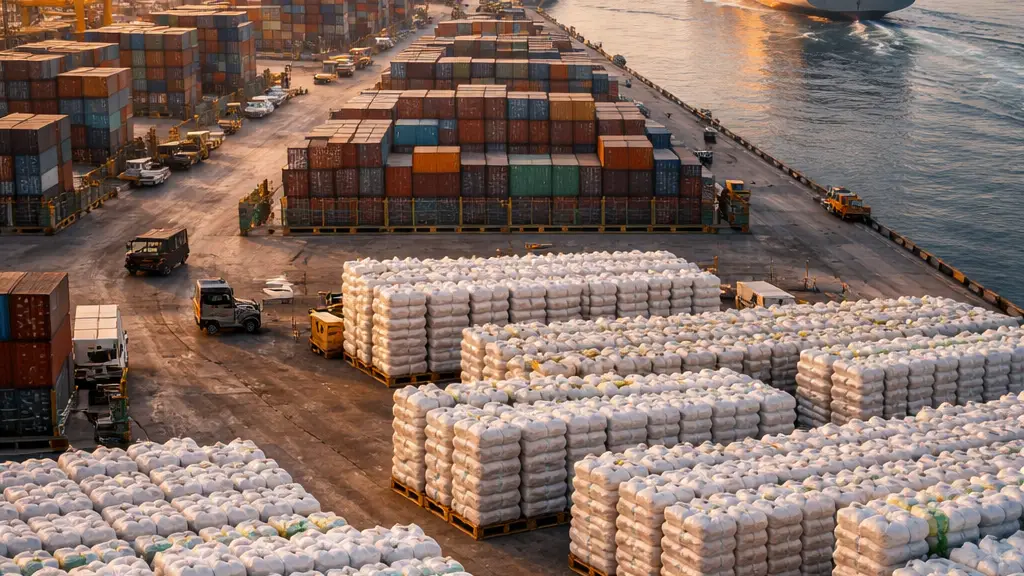
Boric acid ships as a granular or crystalline white solid, packaged in 25 kg bags, 500-1,000 kg jumbo bags (big bags), or in some cases bulk in container. It does not require refrigeration or specialized chemical tanker handling, which simplifies logistics relative to liquid chemicals. The primary export logistics chain runs as follows:
Production site to port: Emet (Kutahya) product moves approximately 200-250 km by rail or road to the port of Gemlik on the Sea of Marmara, or alternatively to Bandirma port. Kirka and Bandirma production has more direct port access. Rail infrastructure connecting the Kutahya/Balikesir production zone to Marmara and Aegean ports is a factor in shipment scheduling and transit time.
Turkish export ports:
- Gemlik (Sea of Marmara): Primary container export hub for European and Asian destinations
- Bandirma (Sea of Marmara): Adjacent to Bandirma refinery; direct loading point
- Mersin (Eastern Mediterranean): Serves Middle Eastern and some Asian routes
- Izmir (Aegean): European and Mediterranean routes
Trade Corridors:
| Route | Transit Mode | Estimated Lead Time | Key Chokepoints |
|---|---|---|---|
| Turkey to Northwest Europe (ARA range) | Container, Sea of Marmara/Aegean | 10-18 days | Bosphorus, Strait of Gibraltar |
| Turkey to India (JNPT/Nhava Sheva) | Container, Mediterranean/Suez/Indian Ocean | 18-30 days | Suez Canal |
| Turkey to China (Shanghai/Tianjin) | Container, via Suez or Cape | 28-40 days | Suez Canal; Cape routing adds 10-14 days |
| Turkey to Japan/South Korea | Container, via Suez or Cape | 30-45 days | Suez Canal |
| Turkey to Southeast Asia | Container, via Suez/Strait of Malacca | 22-35 days | Suez, Malacca Strait |
The Suez Canal remains the critical chokepoint for all Turkey-to-Asia shipments. The 2024 Red Sea shipping disruption, triggered by Houthi attacks on commercial vessels beginning in November 2023 and extending through 2024, forced many carriers onto the Cape of Good Hope routing, adding 10-14 days and 15-25% to freight costs on Asia-bound shipments. Buyers who had not built buffer stock or contractual lead time flexibility faced material availability gaps during this period.
Boric Acid Supply Risk Assessment 2026
| Risk Dimension | Rating | Key Trigger | Historical Precedent |
|---|---|---|---|
| Concentration Risk | CRITICAL | Eti Maden production disruption (earthquake, industrial accident, policy) | 2023 Kahramanmaras earthquake disrupted southern Turkish logistics for 4-6 weeks |
| Geopolitical Risk | HIGH | Turkey-EU trade friction; Turkish export licensing policy change | EU Parliament flagged 98% import dependency in 2024 |
| Logistics Risk | HIGH | Suez Canal closure or Red Sea escalation extends Asia lead times by 10-14 days | 2024 Red Sea rerouting added ~20% to Turkey-Asia freight costs |
| Regulatory Risk | MEDIUM | EU REACH classification of borates as reproductive toxicants restricts some applications | Already in force; limits boron in consumer products |
| Substitution Risk | LOW | No chemical with equivalent properties at comparable cost exists at scale for core applications | Glass, fiberglass, and ceramic applications have no viable boron substitute |
Concentration Risk: CRITICAL
The single most important risk in boric acid supply is that one state-owned company in one country controls the feedstock, refining capacity, and export licensing for approximately three-quarters of the world's boric acid supply. Eti Maden is both the miner and the refiner. Any event that interrupts Eti Maden's production, from seismic activity (Turkey sits in a highly active earthquake zone) to industrial accidents to a unilateral government policy decision to restrict exports, would immediately impact global availability with no alternative source able to fill the gap on a short timeline.
The February 2023 Kahramanmaras earthquakes (magnitude 7.8) did not directly affect Eti Maden's primary production facilities in Kutahya and Balikesir, but they demonstrated how quickly Turkish logistics infrastructure can be disrupted at scale. For buyers who source exclusively from Turkey without safety stock, even a logistics disruption of 4-6 weeks can create production stoppages downstream.
Geopolitical Risk: HIGH
The European Parliament's 2024 question on Turkish boron dependency explicitly named the 98% import reliance as a strategic vulnerability. The EU's Critical Raw Materials Act includes borates on its strategic raw materials list, and formal work on diversification pathways is underway. However, alternative supply sources at commercial scale do not exist today. Serbian borate deposits, Argentinian Atacama brines, and Californian U.S. Borax production are all identified as potential diversification vectors, but none can deliver commercial volumes in the volumes or at the delivered costs that match Turkish supply for European buyers.
Turkey has not imposed boron export restrictions of the type that China has applied to rare earths. However, Eti Maden's pricing is set by the Turkish government, not the market. This means price changes can be driven by Turkish fiscal policy or resource nationalism considerations rather than pure commercial factors.
Logistics Risk: HIGH
European buyers face manageable logistics exposure, as the Turkey-to-ARA route via the Bosphorus and Mediterranean is short enough that disruptions are typically measured in days, not weeks. Asian buyers carry materially higher logistics risk. The Suez Canal dependency means that any recurrence of Red Sea security incidents, another blockage event (as occurred with the Ever Given in 2021), or Bosphorus transit delays can meaningfully extend lead times and compress available supply windows.
What Drives Boric Acid Prices: Feedstocks, Energy, and Market Balance
Boric acid production cost at Emet and Bandirma is driven primarily by sulfuric acid consumption in the colemanite-to-boric-acid reaction, energy costs for processing and drying, and mining operating costs. Unlike petrochemical-derived chemicals, boric acid pricing is not directly indexed to oil or gas prices, which gives it a more stable cost floor in energy price shock scenarios.
Eti Maden sets export prices through negotiated term contracts, typically on a six-month or annual basis. Spot availability outside of term contract frameworks is limited, because Eti Maden does not operate an open spot market. Buyers without term contracts must source from trading companies holding Eti Maden supply, at a premium to contract price.
Key pricing observations for 2026:
- European market: Prices entered 2025 at elevated levels relative to 2022-2023, with supply tightness from maintenance schedules at Eti Maden facilities sustaining a cost-push dynamic. German construction weakness reduced fiberglass demand, providing some offsetting demand pressure. Per IMARC pricing data, Q3 2025 European prices reflected cost inflation from rising freight and inland transport charges rather than a demand surge.
- Asian market (China): Chinese domestic boric acid prices reached approximately 856 USD/MT in June 2025, per IMARC data, with supply influenced by environmental compliance disruptions to domestic Chinese boron mining operations. Import flows from Turkey and South America varied with freight surcharges and port congestion dynamics.
- Indian market: India's Q2 2025 boric acid price index reached approximately INR 95,900/MT CFR JNPT, per Chemanalyst data, up approximately 2% from Q1, with seasonal demand from pharmaceuticals, glass, and pre-Kharif agriculture driving the April-May increase before a June pullback.
- Japan: Q2 2025 prices at approximately 1,076 USD/MT in June, reflecting electronics-grade premium demand.
The global market balance in 2026 reflects a structural dynamic: demand from energy transition applications (fiberglass for wind turbines, borosilicate glass for solar panels, boron in nuclear applications) is growing faster than overall industrial demand, while supply capacity is constrained by the near-monopoly structure of the supply base. This is not a commodity in oversupply. Price spikes are more likely than price collapses.
What Is Changing in Boric Acid Trade Flows
Three structural shifts are reshaping boric acid trade flows as of 2026:
1. U.S. domestic production investment as a strategic response to concentration risk
In April 2024, 5E Advanced Materials launched its first commercial boric acid production at its Fort Cady complex in Southern California, under U.S. government Critical Infrastructure designation. By October 2025, the company had shipped 20 tons of commercial boric acid from the facility. While current output is small relative to global demand, the investment signals that the U.S. is treating domestic boric acid supply as a national security question, not merely a commercial one. This is unlikely to materially redirect global trade flows in the near term but will gradually reduce U.S. dependence on Turkish origin and potentially free up U.S. Borax capacity for export into markets it does not currently prioritize.
2. EU critical raw materials diversification accelerating
The EU's Critical Raw Materials Act, implemented from 2024, sets a benchmark that no single country should supply more than 65% of any strategic raw material. Borates are on the strategic list. The 98% Turkish share far exceeds this target. EU-funded projects to assess Serbian, Portuguese, and other European borate occurrences are underway, but commercial production from any new European source is at minimum a decade away.
3. China's shift from importer to partial self-sufficiency aspirant
China's domestic boron production from Liaoning province is low-purity and insufficient for electronics applications, but Chinese producers have been investing in purification technology. In parallel, China has been increasing imports from South American sources (Chile, Peru) partly as a supply diversification measure. Chinese demand for high-purity Turkish and American boric acid is expected to persist for electronics and pharmaceutical applications regardless of domestic expansion.
What This Means for Boric Acid Buyers in 2026
For European buyers: Your 98% dependency on Turkish origin is a structural feature of the market that will not change within your current planning horizon. The practical risk management question is contract structure and safety stock, not origin diversification. Buyers reliant on spot procurement through trading companies are paying a premium and carrying availability risk that term contract buyers are not. For glass, ceramics, or fiberglass manufacturers consuming boric acid at scale, annual term contracts with six to eight weeks of buffer stock represent the minimum prudent procurement position.
For Indian buyers: The pre-Kharif seasonal demand surge in April to June creates an annual competition for logistics capacity and available spot supply. Pharmaceutical and agricultural buyers who do not have term contracts in place before March face elevated spot pricing and extended lead times during this window. Establishing supply relationships directly with Eti Maden's commercial office or with registered trading companies holding Eti Maden term supply is preferable to entering the spot market during the seasonal peak.
For Asian buyers (China, Japan, South Korea): Logistics risk is the primary concern. The Suez Canal dependency means that any Red Sea escalation recurrence could extend Turkey-to-Asia lead times by two weeks or more with minimal notice. Buyers in these markets should model 45-day safety stock as the minimum for production-critical boric acid grades, and assess whether capacity to source from U.S. Borax through Pacific routing provides a viable alternative circuit breaker for high-purity requirements.
Summary
- Turkey is the market. Eti Maden controls the reserves, the refining, and the pricing. Buyers who do not have a direct or near-direct supply relationship with Eti Maden are exposed to both price premiums and availability risk that term contract holders are not.
- The Suez Canal is Asia's vulnerability. Any disruption to the Suez/Red Sea corridor extends Turkey-to-Asia lead times by 10-14 days minimum. Asian buyers without adequate safety stock have no domestic alternative to cushion that disruption.
- The EU's 98% dependency problem has no short-term solution. The Critical Raw Materials Act creates a policy objective, not a supply solution. European buyers should assume Turkish origin dominance persists through at least 2030 and structure procurement accordingly, rather than waiting for diversification alternatives that are not commercially available today.
For buyers reassessing their boric acid procurement structure ahead of 2026 contract negotiations, the priority actions are: securing term supply directly from Eti Maden or an authorized distributor, building minimum six-to-eight-week safety stock, and identifying one secondary source (U.S. Borax or a South American alternative) for emergency spot access, even at a price premium, for the highest-criticality applications.
Frequently Asked Questions
Q: Who is the largest exporter of boric acid globally?
A: Turkey and the United States are the two dominant boric acid exporters. Turkey, through state-owned Eti Maden, controls approximately 73% of global boron reserves and exports refined boric acid to China, Europe, India, and Japan. In 2022, Turkey exported approximately USD 194 million in boric acid and the U.S. approximately USD 202 million. Turkey's Eti Maden is the world's largest single boron producer, with a statutory monopoly on Turkish boron mining and marketing.
Q: Where does Europe source its boric acid from?
A: The European Union imports approximately 98% of its boron compounds from Turkey, making it near-totally dependent on Eti Maden supply. The EU's Critical Raw Materials Act classifies borates as a strategic raw material partly because of this concentration. Significant borate deposits exist in Serbia, Argentina, Chile, Peru, and the U.S., but none are currently at the commercial scale required to substitute for Turkish origin at European import volumes.
Q: How is boric acid shipped from Turkey to Asia?
A: Turkish boric acid is shipped as a granular solid in 25 kg bags or jumbo bags from Sea of Marmara ports (Gemlik, Bandirma) or Mediterranean ports (Mersin, Izmir), containerized for ocean freight. Asia-bound shipments transit the Suez Canal and Red Sea, with lead times of 28-40 days to China and 30-45 days to Japan and South Korea. When Suez routing is disrupted, Cape of Good Hope rerouting adds approximately 10-14 days to transit time and 15-25% to freight costs.
Q: What drives boric acid prices in 2026?
A: Boric acid prices are primarily driven by Eti Maden's contract pricing decisions (set by the Turkish government rather than open market dynamics), sulfuric acid input costs (used in colemanite-to-boric-acid conversion), energy costs at Eti Maden's Emet refinery, and freight charges on the primary Turkey-to-import-market corridors. Demand from energy transition applications (fiberglass for wind turbines, borosilicate glass for solar) provides structural upward pressure on volume and pricing through the decade.
Q: What is the main supply chain risk for boric acid buyers?
A: The primary risk is concentration in a single state-owned producer. Eti Maden controls the majority of global refined boric acid supply and operates as a government entity, meaning export pricing and availability can be influenced by Turkish fiscal or resource policy, not purely commercial logic. Secondary logistics risk applies particularly to Asia-bound shipments, where Suez Canal disruption can extend lead times by 10-14 days with little notice. Buyers without term contracts or safety stock carry meaningful availability exposure.