Introduction Caustic Soda Flakes
The global cleaning and hygiene industry relies heavily on a small group of core chemical building blocks, and one of the most critical among them is Caustic Soda Flakes (sodium hydroxide flakes, NaOH). From bar soaps and liquid handwash to heavy-duty laundry detergents and industrial cleaners, this versatile alkali plays a central role in formulation, process efficiency, and finished product performance. As demand for hygiene products remains structurally strong after the COVID-19 pandemic, understanding how caustic soda flakes fit into the value chain is increasingly important for application buyers, formulators, and procurement teams worldwide.
By 2026, global consumption of caustic soda (all forms) is expected to be strongly influenced by downstream sectors such as pulp and paper, alumina, textiles, and—importantly for this article—soap and detergents. Industry estimates place global caustic soda demand growth in the range of 3–4% per year, with developing markets in Asia, Africa, and Latin America showing above-average growth due to rising urbanization, improved hygiene awareness, and expanding middle-class consumption of branded detergents and personal care products.
This article provides a detailed, application-focused overview of Caustic Soda Flakes for soap and detergent production with a 2026 horizon. It examines key product properties, industrial specifications, process applications, market dynamics, and sourcing considerations, with a particular emphasis on how global distributors such as chemtradeasia can support buyers in securing reliable and compliant supply across regions.
Global Market Outlook for Caustic Soda Flakes to 2026
Caustic soda is produced primarily via the chlor-alkali process, where brine is electrolyzed to generate chlorine, hydrogen, and sodium hydroxide. The global caustic soda market is closely tied to chlorine demand, and capacity additions are often driven by downstream PVC and other chlorine derivatives. As of the mid-2020s, Asia-Pacific accounts for over half of global caustic soda capacity, with China being the single largest producer, followed by major producers in the Middle East, Europe, and North America. Flake and solid forms represent a significant share of trade because they are easier to ship and store than liquid solutions over long distances.
By 2026, market analysts expect incremental caustic soda capacity to continue emerging in China, India, Southeast Asia, and the Middle East, with some rationalization of older diaphragm and mercury-cell units in Europe and North America due to environmental regulations and energy costs. The shift toward membrane-cell technology is improving product purity and energy efficiency, which is particularly relevant for soap and detergent manufacturers that require consistent, low-impurity Caustic Soda Flakes for high-quality formulations and reduced risk of discoloration or off-odors in finished products.
On the demand side, the soap and detergent sector is forecast to grow faster than mature industrial segments such as alumina in several emerging markets. Rising penetration of automatic washing machines, premium liquid detergents, and specialized cleaning products is increasing the complexity and volume of formulations that use sodium hydroxide directly or indirectly. For application buyers, this means that competition for high-quality caustic soda flakes will remain robust. Partnering with global suppliers like chemtradeasia, which can leverage diversified sourcing from multiple regions, becomes a strategic advantage in managing price volatility, freight disruptions, and regulatory changes through 2026.
Key Properties and Specifications of Caustic Soda Flakes
Caustic Soda Flakes are the solid, flaked form of sodium hydroxide, typically produced by concentrating liquid caustic soda and solidifying it into flakes or pearls. For soap and detergent applications, typical commercial grades are 98–99% NaOH minimum. Moisture content is usually controlled to below 1%, and impurities such as sodium chloride (NaCl), sodium carbonate (Na2CO3), iron, and heavy metals are kept within tight limits. High-purity grades are particularly important for light-colored toilet soaps, transparent soaps, and premium detergents where color stability and low ash content are critical.
Physically, caustic soda flakes are white, hygroscopic, and highly corrosive. They readily absorb moisture and carbon dioxide from the air, forming sodium carbonate on the surface, which can affect the effective alkalinity if storage conditions are poor. Therefore, industrial buyers must consider packaging and storage specifications: flakes are commonly supplied in 25 kg bags, 50 kg bags, or jumbo bags (e.g., 1000–1200 kg), often with inner liners to limit moisture ingress. For large-volume users, chemtradeasia and similar suppliers may also offer customized packaging or palletization to align with plant handling systems and safety protocols.
From a performance perspective, the strong alkalinity of Caustic Soda Flakes (pH around 14 in solution) enables key reactions such as saponification of fats and oils, neutralization of fatty acids, and pH adjustment in detergent slurries. Its high solubility in water and rapid dissolution rate, particularly when flakes are added gradually with proper agitation, make it suitable for batch and continuous processes. Application buyers should evaluate not just nominal purity but also consistency of particle size, dissolution behavior, and trace impurity profile, as these factors can influence process control, equipment fouling, and end-product quality.
Applications of Caustic Soda Flakes in Soap and Detergent Manufacturing
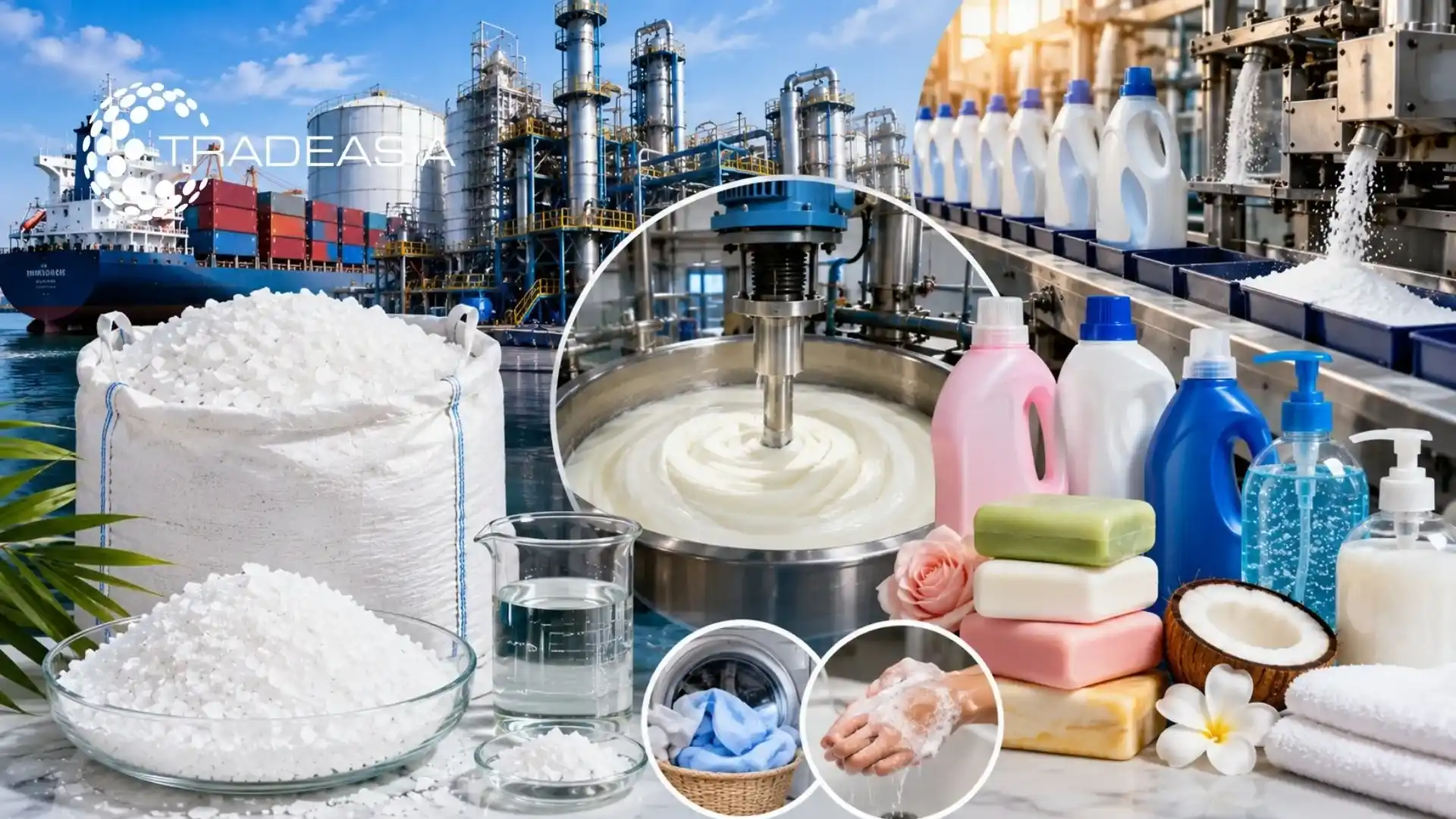
The most classical application of Caustic Soda Flakes in the soap industry is in the saponification of triglycerides—fats and oils such as tallow, palm oil, coconut oil, and other vegetable oils. In bar soap manufacturing, sodium hydroxide reacts with these triglycerides to form sodium soaps and glycerin. The quality of the caustic soda directly affects reaction efficiency, yield, and the physical properties of the soap, including hardness, foaming behavior, and color. For toilet soaps and beauty bars, where sensory attributes and appearance are paramount, consistent, low-impurity flakes are preferred to minimize darkening and ensure stable fragrance performance.
In the detergent industry, Caustic Soda Flakes are widely used to neutralize fatty acids to produce soap noodles or soap chips, which are then blended with synthetic surfactants, builders, and additives to create laundry bars, multipurpose bars, and some powder detergents. Sodium hydroxide solutions prepared from flakes also serve as pH adjusters and neutralizing agents in the manufacture of anionic surfactants such as linear alkylbenzene sulfonate (LAS) and alcohol ether sulfates (AES). Maintaining the correct alkalinity is crucial for optimal surfactant performance, stability, and compatibility with enzymes and optical brighteners in modern detergent formulations.
Beyond primary saponification and neutralization, Caustic Soda Flakes play a supporting role in several ancillary processes within soap and detergent plants. They are used for cleaning and CIP (clean-in-place) operations in reactors, mixers, and pipelines, helping remove fatty residues and scale. They also assist in the treatment of wastewater generated by manufacturing operations, where sodium hydroxide is dosed to adjust pH before biological treatment or discharge. Application buyers should therefore view caustic soda flakes not only as a raw material for formulations but as a multifunctional utility chemical that affects operational reliability, hygiene standards, and environmental compliance across the facility.
Sourcing, Logistics, and Supplier Considerations
For global application buyers, sourcing Caustic Soda Flakes is not just about price; it is about ensuring supply security, quality consistency, and regulatory compliance across multiple jurisdictions. Market conditions in the mid-2020s have underscored the importance of diversified sourcing strategies, as disruptions in container availability, port congestion, and regional energy price spikes can quickly translate into shortages or cost surges. Buyers in the soap and detergent sector, especially contract manufacturers and brands operating plants in different countries—benefit from working with international distributors such as chemtradeasia, which aggregate supply from multiple production hubs and manage cross-border logistics.
chemtradeasia positions itself as a global chemical trading and distribution platform that connects producers of caustic soda in Asia, the Middle East, and other regions with industrial users worldwide. For soap and detergent manufacturers, this can mean access to a range of product grades (e.g., 98–99% NaOH flakes, different packing formats) and origin options, enabling optimization of landed cost and risk diversification. In addition, experienced distributors provide documentation support, including certificates of analysis (COA), material safety data sheets (MSDS/SDS), REACH or other regional registrations where applicable, and assistance with customs and regulatory procedures.
From a practical standpoint, application buyers should evaluate suppliers on several criteria: traceable quality assurance systems (ISO certifications, consistent COAs), alignment with local and international safety regulations, robust packaging suited to climatic conditions, and the ability to offer flexible shipment sizes—from full container loads for large plants to smaller consolidated shipments for regional producers. chemtradeasia and similar platforms can also provide market intelligence on price trends, freight conditions, and supply-demand balance, helping procurement teams plan forward contracts or spot purchases more effectively as they navigate the 2026 outlook for Caustic Soda Flakes.
Conclusion
As the global soap and detergent industry continues to evolve toward more sophisticated, performance-oriented, and environmentally conscious formulations, Caustic Soda Flakes remain a foundational raw material. Their role in saponifying fats and oils, neutralizing fatty acids, adjusting pH, and supporting plant hygiene and wastewater treatment makes them indispensable across both traditional bar soap manufacturing and modern detergent production lines. With demand for hygiene products expected to remain structurally strong through 2026 and beyond, reliable access to high-quality sodium hydroxide flakes will be a key enabler for producers seeking to meet consumer expectations and regulatory standards.
For application buyers, a clear understanding of product specifications, purity requirements, and process implications is essential. Evaluating caustic soda flakes on parameters such as NaOH content, impurity profile, moisture sensitivity, and dissolution characteristics can significantly impact operational efficiency and end-product quality. At the same time, the broader market context, capacity shifts in the chlor-alkali sector, energy and freight cost volatility, and regional regulatory trends, must be factored into sourcing strategies. Working with experienced, globally connected partners like chemtradeasia can help manufacturers secure consistent supply, optimize logistics, and access timely market insights that support more resilient procurement decisions.
This article is intended solely for informational and market insight purposes and does not constitute technical, safety, engineering, or other professional advice. Users should independently verify all information with qualified experts, consult official documentation such as MSDS/SDS and relevant regulations, and contact their suppliers or our team for guidance on specific applications, handling, and safety requirements before making operational decisions.