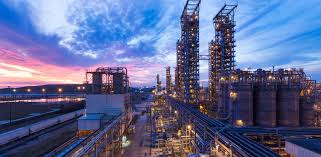
The $8.5 billion Golden Triangle Polymers project in Orange, Texas, is increasingly becoming an important benchmark for the U.S. petrochemical industry's unusually thin pipeline of major new capacity.
The joint venture between Chevron Phillips Chemical and QatarEnergy is now moving through commissioning and startup activities, with full operations expected in 2027. That makes Golden Triangle more than a proposed project on an industry pipeline: it is one of the few major U.S. petrochemical investments actually progressing toward commercial production.
The contrast is important because the U.S. Gulf Coast experienced an enormous petrochemical construction wave during the previous decade, but the number of new world-scale projects moving forward has fallen sharply as global polyethylene and petrochemical markets confront overcapacity.
A $8.5 Billion Bet on U.S. Ethane Economics
Golden Triangle Polymers is designed as a fully integrated facility consisting of:
A 2,080 KTA ethane cracker
Two 1,000 KTA high-density polyethylene (HDPE) units
Total installed investment of approximately $8.5 billion
More than 500 permanent jobs
Approximately 4,500 construction jobs
CPChem owns 51% of the joint venture, while QatarEnergy owns 49%. CPChem is responsible for construction management and will operate the facility after startup.
The configuration gives the project a major feedstock advantage: U.S. ethane is converted into ethylene and then directly into polyethylene at the same integrated site.
That vertical integration is particularly valuable in a market where margins can be squeezed at individual points of the petrochemical chain.
The Project Has Reached a Different Stage Than Many U.S. Proposals
Golden Triangle's significance comes partly from its execution.
The project received final investment approval in 2022 and construction began in 2023. By 2026, the facility had entered its commissioning and startup phase, with heavy-haul module deliveries completed and supporting infrastructure such as the site's rail yard commissioned.
The current timeline calls for full operational startup in 2027.
This matters because the U.S. petrochemical project pipeline increasingly contains a distinction between:
Projects that have been announced
and
Projects that are actually being built and commissioned.
Golden Triangle belongs firmly in the second category.
Why the U.S. Petrochemical Pipeline Has Become Thin
The reduction in new projects is largely a response to market conditions.
The U.S. benefited from an enormous shale-driven petrochemical investment cycle after the expansion of domestic natural-gas production created abundant supplies of low-cost ethane.
But that investment cycle also contributed to substantial new global polyethylene capacity.
With China and other Asian producers adding significant petrochemical capacity, global markets now face a supply-demand imbalance that makes additional greenfield projects harder to justify.
ICIS described the U.S. chemical project pipeline in early 2026 as continuing to experience a project drought, with Golden Triangle potentially standing out as the only major project capable of starting up during 2026/early 2027.
That makes Golden Triangle strategically unusual even before considering its scale.
Golden Triangle vs. the Broader Pipeline
The contrast can be summarized through the industry's changing investment environment.
Project / Trend | Current signal | Strategic implication |
|---|---|---|
Golden Triangle Polymers | Commissioning/startup phase | Major U.S. capacity actually advancing |
U.S. greenfield petrochemical projects | Limited | High investment hurdle |
Global PE capacity additions | Strong | Continued oversupply risk |
U.S. ethane advantage | Structural | Supports competitive production costs |
Existing U.S. plants | More important | Brownfield expansions can be easier to justify |
New mega-projects | Selective | Companies increasingly require stronger economics |
The result is a U.S. petrochemical market where existing advantaged assets matter more than simply announcing new capacity.
The Timing Is Both an Advantage and a Risk
Golden Triangle is arriving at an interesting point in the cycle.
On one hand, its scale and integration give it the potential to become a highly competitive producer. The facility uses modern technology and is designed to have greenhouse-gas emissions approximately 25% lower than comparable U.S. and European facilities, according to the project developers.
On the other hand, the project is entering the market while global polyethylene supply remains under pressure.
That creates a paradox:
Golden Triangle may be one of the strongest new U.S. projects economically, while simultaneously entering one of the most difficult global PE markets in years.
QatarEnergy's Role Adds a Global Dimension
The project is also significant because it demonstrates the continued internationalization of U.S. petrochemical investment.
QatarEnergy's 49% ownership gives the project access to the financial and strategic capabilities of one of the world's largest integrated energy companies, while CPChem brings U.S. petrochemical operating and engineering expertise.
The partnership also reflects a broader Gulf strategy of participating in downstream assets outside the Middle East.
Rather than simply exporting hydrocarbons, Gulf producers increasingly seek value capture through integrated petrochemical investments in major consuming markets.
Golden Triangle Is Not Just About Polyethylene
The project's impact extends beyond the polyethylene market.
Its 2,080 KTA ethane cracker represents additional U.S. ethylene capacity, while the two HDPE units create downstream demand for that ethylene.
Polyethylene produced at the site can ultimately enter packaging, pipe, containers and other industrial applications.
That means the facility will influence several connected markets:
Ethane → Ethylene → HDPE → Packaging / Pipe / Industrial Products
Its integrated structure reduces the number of external supply-chain dependencies between feedstock and finished polymer.
Why the Project Pipeline Matters More Than the Project Count
The most important intelligence signal is not simply that fewer U.S. petrochemical projects are being announced.
It is that the economics of new greenfield capacity have fundamentally changed.
During the earlier shale boom, cheap feedstock alone could justify enormous investments.
Today, producers must also consider:
Global polyethylene oversupply
Chinese petrochemical expansion
Long-term demand growth
Carbon costs and emissions requirements
Construction inflation
Financing costs
Export competitiveness
Regional infrastructure
Feedstock availability
That makes a project like Golden Triangle increasingly difficult to replicate.
The U.S. Advantage Is Shifting From Expansion to Asset Quality
The next phase of U.S. petrochemical competitiveness may therefore be less about building dozens of new crackers and more about maximizing the economics of the assets already in place.
The winners are likely to be producers with:
Low-cost ethane access
Integrated cracker-to-polymer operations
Efficient logistics
Modern production technology
Large-scale facilities
Reliable export infrastructure
Strong balance sheets
Golden Triangle checks many of these boxes.
Ranking Golden Triangle's Strategic Position
From an industry-intelligence perspective, the project ranks highly across several dimensions:
1. Project scale — exceptional.
At $8.5 billion, Golden Triangle is a genuine world-scale petrochemical investment.
2. Execution status — strong.
The facility has progressed into commissioning and startup rather than remaining an announced project.
3. Feedstock position — strong.
The integrated ethane-to-polyethylene configuration leverages the U.S. Gulf Coast's feedstock advantage.
4. Global market timing — challenging.
The project enters a market facing substantial global polyethylene capacity additions.
5. Replicability — limited.
The combination of scale, financing, feedstock economics and long development timelines makes another comparable U.S. greenfield project difficult to justify under current market conditions.
The Intelligence Takeaway
Golden Triangle Polymers is becoming an important symbol of how dramatically the U.S. petrochemical investment landscape has changed.
During the shale-driven expansion, the question was how many new petrochemical projects could the United States build?
Today, the question is closer to which projects can still justify the billions of dollars required to build them?
Golden Triangle's $8.5 billion investment stands out because it has moved from investment decision to construction and now into commissioning, with full startup expected in 2027.
Its success could reinforce the case for further U.S. investments in advantaged, integrated petrochemical assets. But continued global overcapacity could simultaneously discourage the next generation of greenfield projects.
That makes Golden Triangle both a new source of U.S. polyethylene supply and a benchmark for how difficult it has become to build the next major U.S. petrochemical complex.
Calcium Carbonate (Feed Grade) CAS: 2836-50-00