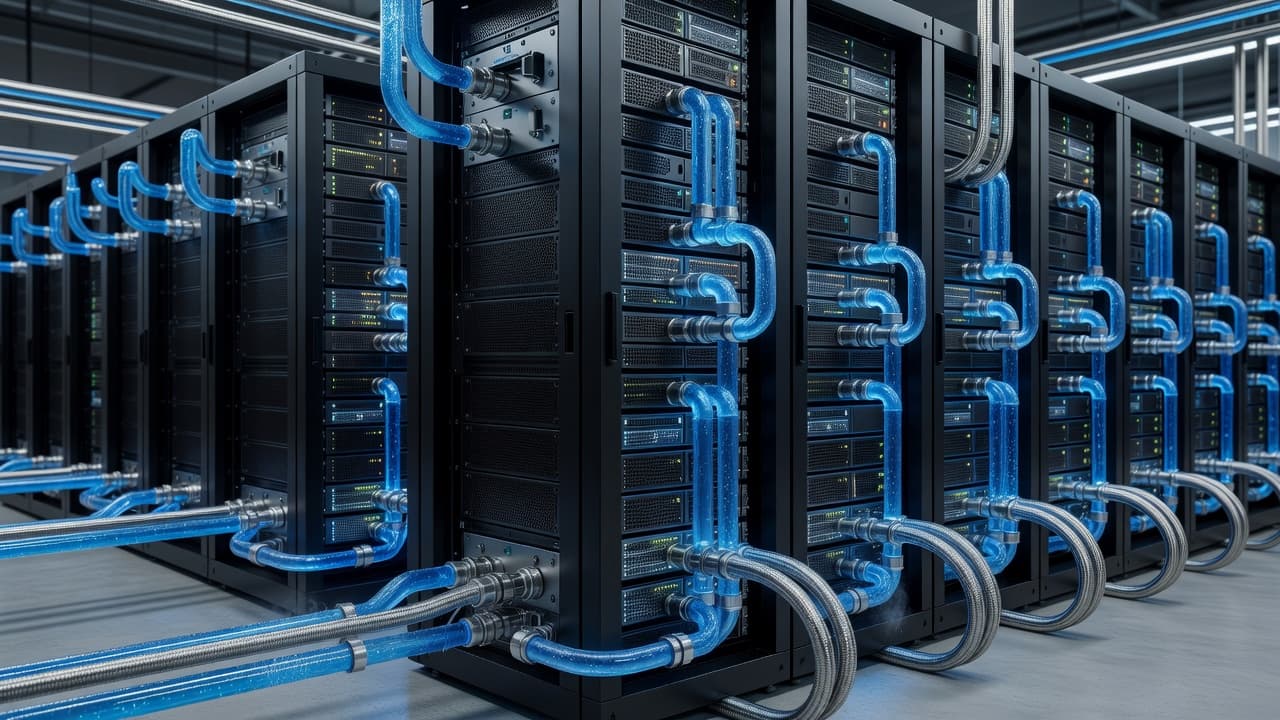
AI infrastructure is becoming one of the fastest emerging demand drivers in the global chemical industry. The chemical demand outlook tied to AI data centers is shifting rapidly as computing density rises and thermal limits force a transition from air cooling to advanced liquid systems.
Rack power densities have increased from 5–15 kW to more than 100 kW in leading edge facilities. This shift has created a structural break in cooling design, where traditional airflow systems no longer meet thermal requirements.
Global active data center capacity is forecast to expand to 147.1 GW by 2035. This expansion directly translates into new chemical demand across cooling, semiconductor manufacturing and system protection layers.
AI data centers reshaping industrial chemical consumption patterns
AI workloads are fundamentally changing how data centers are built and operated. High performance computing clusters generate concentrated heat loads that require continuous thermal stabilization.
This has transformed chemical demand from a peripheral input to a core infrastructure requirement. Cooling chemistry is now embedded directly into server architecture rather than external HVAC systems.
Key structural shifts include:
Transition from air cooling to liquid cooling systems at scale
Rising demand for engineered dielectric fluids
Increased dependency on ultra pure water loops and treatment systems
These changes are creating entirely new chemical value chains linked to digital infrastructure rather than traditional industrial manufacturing.
Liquid cooling chemistry driving new high value chemical demand
Liquid cooling has become the defining chemical application inside AI data centers. As rack densities exceed 30 kW and move toward 100 kW, air cooling becomes physically inefficient and energy intensive.
This shift drives demand for engineered fluids and thermal management chemicals that can operate under continuous high load conditions.
Core liquid cooling chemical categories include:
Monoethylene glycol based heat transfer fluids used in closed loop systems
Propylene glycol blends for non toxic thermal regulation
Specialty dielectric fluids designed for direct-to-chip cooling
These fluids must maintain stability under extreme temperature cycles while avoiding electrical conductivity risks.
Performance requirements include:
High thermal conductivity for efficient heat transfer
Low viscosity for rapid circulation
Chemical stability under long operational lifecycles
Liquid cooling chemistry is now a critical bottleneck in scaling AI infrastructure globally.
Ultra pure water and corrosion control systems in AI infrastructure
Water remains a core component of data center cooling systems, particularly in hybrid and indirect liquid cooling designs. However, the purity requirements are significantly higher than conventional industrial water systems.
Deionised and ultra pure water systems require advanced treatment chemicals to maintain conductivity levels close to zero.
Key chemical inputs include:
Deionisation resins and polishing agents
Corrosion inhibitors for closed loop piping systems
Biocides to prevent microbial growth in cooling circuits
Corrosion control becomes critical due to continuous circulation cycles and sensitive electronic environments.
These requirements significantly increase chemical intensity per megawatt of data center capacity.
Semiconductor manufacturing chemicals powering AI chip supply chains
AI data centers do not only consume chemicals during operation. They also depend heavily on semiconductor manufacturing processes that require ultra pure chemical inputs.
Chip fabrication involves multiple chemical-intensive steps including cleaning, etching and deposition.
Critical semiconductor chemicals include:
Hydrogen peroxide for wafer cleaning processes
Hydrofluoric acid and hydrochloric acid for etching and surface preparation
Ultra pure solvents for lithography and pattern development
Additional gases and materials include helium for cooling and nitrogen for inert processing environments.
Supply chains for these chemicals are highly sensitive to contamination risks, requiring strict purification and certification standards.
Regulatory acceleration and TSCA oversight of AI chemical demand
Regulatory frameworks are beginning to recognize AI infrastructure as a distinct chemical demand driver. In September 2025, the US Environmental Protection Agency introduced a priority TSCA review track specifically targeting data center related chemicals Environmental Protection Agency.
This regulatory shift reflects concerns over:
Chemical safety in large scale cooling systems
Environmental impact of high volume water treatment
Lifecycle management of engineered fluids
The introduction of faster review pathways signals that AI infrastructure chemicals will face accelerated compliance scrutiny as demand scales.
Procurement teams must now factor regulatory approval timelines into supplier qualification processes.
Corporate investment signals and strategic market validation
Major industrial players are already positioning for this chemical demand expansion. One of the clearest signals is the acquisition of CoolIT Systems by Ecolab in 2026 for USD 4.75 billion.
Ecolab has historically focused on water, hygiene and infection prevention solutions. The move into AI cooling systems signals a strategic expansion into digital infrastructure chemistry.
CoolIT Systems specializes in liquid cooling technology for high performance computing and data centers. Its integration into a major water treatment and chemical services company highlights the convergence of chemical engineering and digital infrastructure.
This acquisition reflects three structural realities:
AI infrastructure requires chemical and thermal engineering integration
Cooling systems are becoming a major chemical consumption channel
Water and dielectric fluid markets are converging under one supply chain
Fire suppression and inert gases in high density computing environments
As data centers increase in density, fire risk management becomes more complex. Traditional suppression systems are not suitable for sensitive electronic environments.
This drives demand for specialty fire suppressants and inert gas systems that avoid damage to electronic components.
Key chemical and gas systems include:
Clean agent fire suppressants designed for electronics
Nitrogen based inert gas systems for oxygen displacement
Helium applications in controlled semiconductor environments
These systems must balance fire safety with equipment preservation, creating strict performance and environmental requirements.

Supply chain complexity and chemical intensity per megawatt
AI data centers significantly increase chemical intensity per unit of energy consumption. Unlike traditional industrial systems, these facilities require continuous chemical circulation in multiple subsystems.
Chemical demand is embedded across:
Cooling loop chemistry for thermal regulation
Semiconductor supply chains for chip fabrication
Water purification systems for operational stability
Fire suppression and safety systems
This creates a layered chemical dependency that scales directly with compute demand.
Procurement teams face several challenges:
High specification variability across cooling technologies
Long qualification cycles for dielectric and ultra pure fluids
Limited supplier base for advanced engineered chemicals
These constraints make supply chain resilience as important as cost optimization.
Market outlook for AI driven chemical demand expansion
AI infrastructure is expected to remain one of the fastest growing chemical demand segments through 2035. The combination of rising rack densities and global data center expansion ensures sustained growth in cooling and semiconductor chemicals.
Growth will concentrate in:
Liquid cooling fluids and engineered dielectric systems
Ultra pure water treatment chemicals
Semiconductor manufacturing inputs linked to AI chip production
The shift is not incremental. It represents a structural transformation in how chemicals integrate with digital infrastructure.

As AI workloads expand, chemical suppliers will increasingly compete on engineering capability rather than commodity pricing.
What procurement teams need to prepare for in AI chemical markets
Procurement strategies must evolve to address the convergence of digital infrastructure and chemical engineering. AI data centers introduce new risk profiles that differ from traditional industrial chemical markets.
Key priorities include:
Securing long term supply of dielectric and thermal fluids
Building qualification pipelines for ultra pure water treatment systems
Diversifying semiconductor chemical suppliers across regions
Regulatory compliance will also become central to sourcing decisions. Faster review pathways such as TSCA prioritization indicate that chemical approval cycles will influence infrastructure rollout speed.
Procurement teams that align early with AI driven chemical demand curves will gain long term supply security in one of the fastest growing industrial segments.
Ready to source monoethylene glycol from verified global suppliers? Explore competitive offers on our platform today.
Monoethylene glycol CAS: 107-21-1